
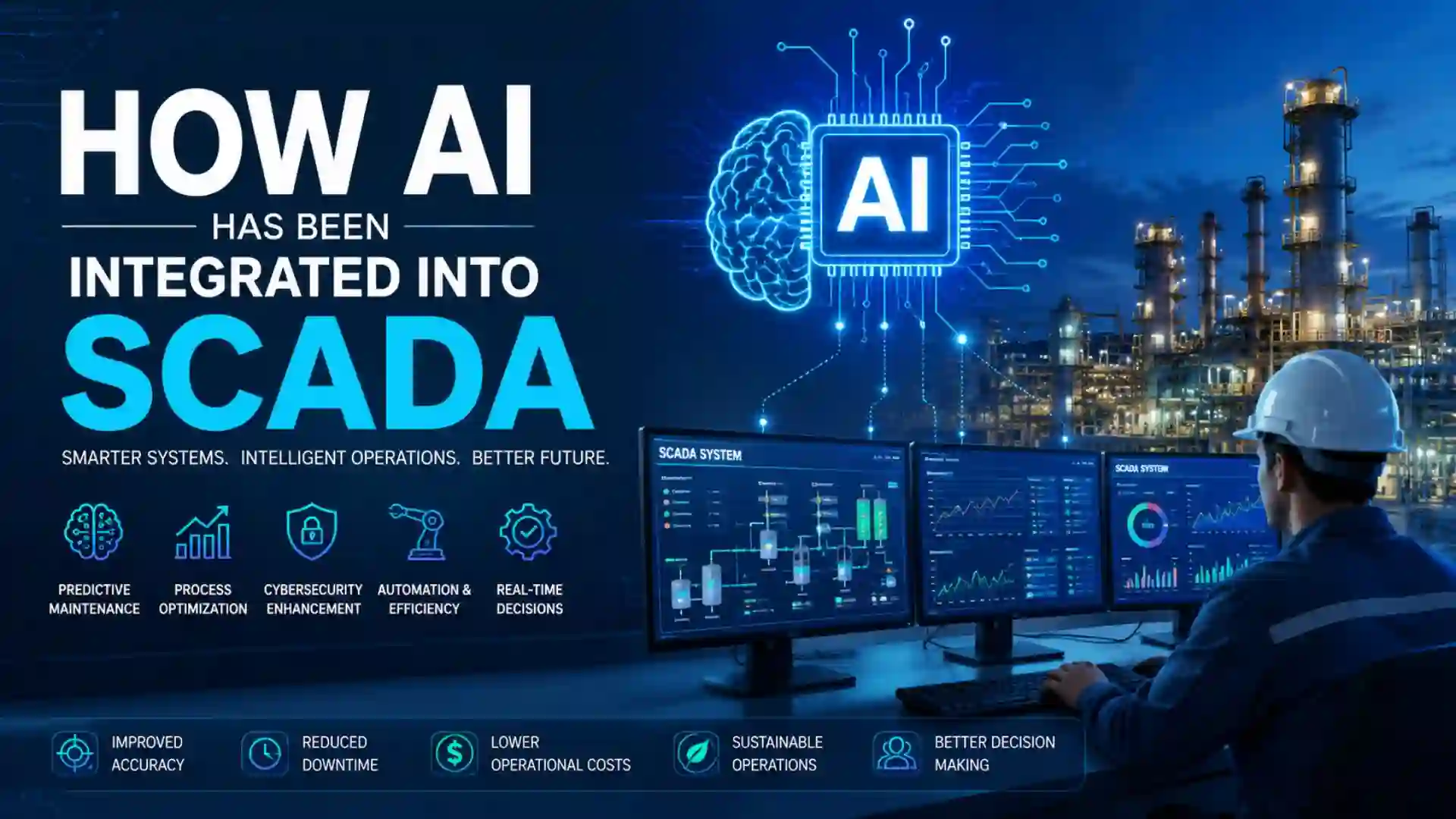
How AI Has Been Integrated Into SCADA: Supervisory Control and Data Acquisition (SCADA) systems have long served as the backbone of industrial automation. Industries such as manufacturing, power generation, oil and gas, water treatment, transportation, and utilities rely on SCADA systems to monitor equipment, collect data, and control industrial processes in real time. Over the past decade, the integration of Artificial Intelligence (AI) into SCADA systems has transformed the industrial landscape by making operations more intelligent, predictive, secure, and efficient.
AI integration in SCADA is not simply an upgrade in software functionality. It represents a major shift from reactive industrial management to proactive and autonomous operations. Traditional SCADA systems were designed primarily for monitoring and control, but AI enables these systems to analyze large volumes of data, identify patterns, predict failures, optimize operations, and support automated decision-making.
This article explores how AI has been integrated into SCADA systems, the technologies involved, the practical applications across industries, the benefits and challenges, and the future of intelligent industrial automation.
Understanding SCADA Systems
A SCADA system is an industrial control system used to supervise and manage industrial operations remotely. It gathers data from sensors, programmable logic controllers (PLCs), and remote terminal units (RTUs), then presents the information to operators through Human Machine Interfaces (HMIs).
The primary functions of a SCADA system include:
- Data acquisition
- Real-time monitoring
- Process control
- Alarm handling
- Historical data logging
- Reporting and analytics
Traditional SCADA systems operated based on predefined rules and programmed instructions. Human operators were responsible for analyzing trends and making operational decisions. While effective, these systems had limitations in handling massive data streams, detecting hidden anomalies, or adapting dynamically to changing industrial conditions.
AI integration addresses these limitations by introducing machine learning, predictive analytics, intelligent automation, and advanced data processing capabilities.
The Evolution of AI in SCADA
The integration of AI into SCADA systems evolved gradually due to advancements in several technologies:
- Industrial Internet of Things (IIoT)
- Cloud computing
- Big data analytics
- Machine learning algorithms
- Edge computing
- High-speed communication networks
- Advanced sensors
Initially, SCADA systems focused only on data visualization and alarm management. As industrial environments generated increasing volumes of operational data, industries needed smarter systems capable of extracting valuable insights automatically.
AI became the solution for transforming raw industrial data into actionable intelligence. Modern SCADA systems now combine operational technology (OT) with information technology (IT), enabling real-time analytics, predictive maintenance, and autonomous process optimization.
Core AI Technologies Integrated into SCADA
Machine Learning
Machine learning algorithms are among the most important AI technologies integrated into SCADA systems. These algorithms learn from historical operational data and identify patterns that help predict future events.
Machine learning in SCADA is commonly used for:
- Equipment failure prediction
- Anomaly detection
- Process optimization
- Quality control
- Energy consumption forecasting
For example, a machine learning model can analyze temperature, pressure, vibration, and current data from industrial equipment to predict a motor failure before it occurs.
Deep Learning
Deep learning models process highly complex industrial datasets and identify intricate relationships between variables. Deep learning is particularly useful in:
- Visual inspection systems
- Image recognition
- Defect detection
- Video surveillance
- Advanced process automation
In manufacturing plants, deep learning models integrated with SCADA systems can analyze camera feeds to identify defects in products during production.
Predictive Analytics
Predictive analytics enables SCADA systems to forecast future operational conditions. Instead of waiting for equipment failures, industries can schedule maintenance proactively.
Predictive analytics helps industries:
- Reduce downtime
- Improve asset reliability
- Lower maintenance costs
- Increase production efficiency
This technology is widely used in power plants, oil refineries, and manufacturing facilities.
Natural Language Processing
Natural Language Processing (NLP) allows operators to interact with SCADA systems using human language. AI-powered assistants can interpret operator queries and provide operational insights.
Examples include:
- Voice-based system commands
- Automated report generation
- Intelligent alarm interpretation
- Conversational dashboards
NLP improves operational accessibility and simplifies complex industrial monitoring tasks.
Computer Vision
Computer vision enables SCADA systems to interpret visual information from cameras and imaging devices.
Applications include:
- Worker safety monitoring
- Equipment inspection
- Fire and smoke detection
- Leak detection
- Automated quality inspection
Computer vision systems integrated with SCADA can continuously monitor industrial facilities without human intervention.
Reinforcement Learning
Reinforcement learning allows AI systems to optimize industrial processes through continuous trial-and-error learning.
This technology is used for:
- Energy optimization
- Autonomous process control
- Dynamic production scheduling
- Smart grid management
Over time, reinforcement learning systems improve operational efficiency by identifying the best control strategies.
How AI Has Been Integrated into SCADA Architectures?
AI at the Edge
Modern SCADA systems increasingly use edge computing to process data near industrial equipment instead of sending all data to centralized servers.
Edge AI provides several advantages:
- Faster response times
- Reduced latency
- Lower bandwidth usage
- Improved reliability
- Enhanced cybersecurity
For example, AI algorithms deployed at edge devices can instantly detect abnormal machine vibrations and trigger emergency shutdowns.
Cloud-Based AI Integration
Cloud platforms allow SCADA systems to store and analyze massive datasets. AI models hosted in the cloud perform advanced analytics and predictive calculations.
Cloud integration enables:
- Centralized monitoring
- Remote analytics
- Scalable AI processing
- Cross-site operational intelligence
Industries operating multiple facilities can use cloud AI systems to compare operational performance across locations.
Digital Twins
A digital twin is a virtual replica of a physical industrial system. AI-powered digital twins simulate real-world operations and predict system behavior.
Digital twins integrated with SCADA systems help industries:
- Test operational changes safely
- Predict equipment failures
- Optimize production processes
- Improve maintenance planning
This approach significantly reduces operational risks.
Integration with IIoT Devices
AI-enhanced SCADA systems rely heavily on Industrial Internet of Things devices. Sensors continuously collect operational data such as:
- Temperature
- Pressure
- Flow rate
- Humidity
- Vibration
- Voltage
AI algorithms analyze this data in real time to identify abnormalities and optimize system performance.
Applications of AI in SCADA Systems
Predictive Maintenance
Predictive maintenance is one of the most successful AI applications in SCADA systems.
Traditional maintenance approaches include:
- Reactive maintenance
- Preventive maintenance
Reactive maintenance causes unexpected downtime, while preventive maintenance may replace components unnecessarily.
AI-driven predictive maintenance solves these problems by forecasting failures before they occur.
Benefits include:
- Reduced equipment downtime
- Lower repair costs
- Extended equipment lifespan
- Improved operational efficiency
Industries such as manufacturing, aviation, and power generation heavily use predictive maintenance systems.
Intelligent Alarm Management
Traditional SCADA systems often generate excessive alarms, leading to alarm fatigue among operators.
AI improves alarm management by:
- Filtering false alarms
- Prioritizing critical alerts
- Identifying alarm patterns
- Suggesting corrective actions
This helps operators focus on high-priority issues and respond more effectively.
Process Optimization
AI continuously analyzes operational data to improve industrial processes.
Examples include:
- Optimizing chemical reactions
- Adjusting production parameters
- Reducing energy consumption
- Improving production quality
AI-driven optimization can significantly increase industrial profitability.
Energy Management
Energy-intensive industries use AI-integrated SCADA systems to monitor and optimize energy consumption.
Applications include:
- Smart grid management
- Load forecasting
- Peak demand reduction
- Renewable energy integration
AI helps industries reduce operational costs and support sustainability goals.
Cybersecurity Enhancement
Industrial cybersecurity has become a major concern as SCADA systems become increasingly connected.
AI enhances SCADA cybersecurity through:
- Real-time threat detection
- Network anomaly analysis
- Intrusion detection systems
- Behavioral monitoring
AI systems can identify unusual network activity that may indicate cyberattacks.
Autonomous Industrial Operations
AI integration enables autonomous decision-making in industrial environments.
Examples include:
- Automated production scheduling
- Self-adjusting control systems
- Autonomous robotics coordination
- Dynamic process balancing
These capabilities reduce the need for constant human intervention.
AI in Different Industries Using SCADA
Manufacturing Industry
Manufacturing industries use AI-integrated SCADA systems for:
- Production line optimization
- Quality inspection
- Predictive maintenance
- Robotic automation
- Inventory management
Smart factories rely heavily on AI-powered industrial automation.
Oil and Gas Industry
The oil and gas industry uses AI in SCADA systems for:
- Pipeline monitoring
- Leak detection
- Drilling optimization
- Equipment health monitoring
- Remote facility management
AI helps improve safety and reduce operational risks in hazardous environments.
Power Generation and Utilities
Power utilities integrate AI with SCADA for:
- Grid balancing
- Fault prediction
- Renewable energy forecasting
- Load management
- Power quality analysis
AI improves the reliability and stability of power systems.
Water Treatment Plants
Water treatment facilities use AI-enhanced SCADA systems for:
- Water quality monitoring
- Leak detection
- Chemical dosing optimization
- Pump performance analysis
- Energy management
AI helps ensure efficient and safe water distribution.
Transportation Systems
Transportation infrastructure uses AI-integrated SCADA systems for:
- Traffic monitoring
- Railway signaling
- Tunnel safety systems
- Airport operations
- Smart transportation management
AI improves operational efficiency and passenger safety.
Important Information and Reference
| Topic | Description | Importance |
|---|---|---|
| SCADA | Supervisory Control and Data Acquisition system | Central industrial monitoring and control |
| AI Integration | Use of intelligent algorithms in industrial systems | Enables automation and predictive analysis |
| Machine Learning | Data-driven predictive algorithms | Failure prediction and optimization |
| Deep Learning | Advanced neural network processing | Image analysis and defect detection |
| Predictive Maintenance | Forecasting equipment failures | Reduces downtime and maintenance costs |
| Edge Computing | Localized data processing | Faster decision-making |
| Cloud SCADA | Cloud-based industrial monitoring | Scalability and remote access |
| IIoT | Industrial Internet of Things devices | Real-time industrial data collection |
| Digital Twin | Virtual model of industrial systems | Simulation and optimization |
| Cybersecurity AI | AI-driven threat detection | Protects industrial infrastructure |
| Computer Vision | AI image recognition systems | Automated inspection and safety monitoring |
| NLP in SCADA | Human-language interaction systems | Simplifies operator communication |
| Smart Manufacturing | AI-powered industrial automation | Increased productivity |
| Energy Optimization | AI-based energy management | Reduces operational costs |
| Autonomous Control | Self-operating industrial systems | Improves efficiency and responsiveness |
Benefits of AI Integration in SCADA
Improved Operational Efficiency
AI enables industrial systems to operate more efficiently through intelligent process optimization and automation.
Reduced Downtime
Predictive maintenance minimizes unexpected equipment failures and production interruptions.
Enhanced Decision-Making
AI systems analyze large datasets quickly and provide actionable insights for operators and management.
Better Resource Utilization
AI helps optimize energy, raw materials, and workforce utilization.
Increased Safety
AI-powered monitoring systems detect hazardous conditions and prevent industrial accidents.
Scalability
Cloud-based AI systems allow industries to expand operations without major infrastructure limitations.
Real-Time Intelligence
AI provides real-time analytics and immediate operational recommendations.
Challenges of AI Integration in SCADA
Cybersecurity Risks
As SCADA systems become more connected, they become more vulnerable to cyberattacks.
Data Quality Issues
AI systems require accurate and high-quality data for reliable predictions.
Integration Complexity
Integrating AI into legacy SCADA systems can be technically challenging.
High Initial Investment
AI deployment requires investments in infrastructure, sensors, software, and skilled personnel.
Lack of Skilled Workforce
Industries need professionals with expertise in both industrial automation and AI technologies.
Regulatory and Compliance Concerns
Industrial sectors must comply with strict safety and operational regulations.
Future of AI in SCADA Systems
The future of AI-integrated SCADA systems is expected to include:
- Fully autonomous industrial operations
- Self-healing industrial systems
- Advanced digital twins
- AI-driven sustainability optimization
- Quantum computing integration
- 5G-enabled industrial communication
- Collaborative industrial robotics
- Hyper-intelligent predictive systems
As AI technology continues to evolve, SCADA systems will become more adaptive, resilient, and intelligent.
Industries are moving toward Industry 4.0 and smart factory ecosystems where AI-driven SCADA systems play a central role. The combination of AI, IoT, cloud computing, robotics, and edge analytics will redefine industrial automation in the coming years.
FAQ about How AI Has Been Integrated Into SCADA Systems
What is AI-integrated SCADA?
AI-integrated SCADA refers to the combination of artificial intelligence technologies with traditional SCADA systems to improve automation, analytics, predictive maintenance, and operational decision-making.
Why is AI important in SCADA systems?
AI helps SCADA systems process large amounts of industrial data, identify patterns, predict failures, optimize operations, and improve efficiency.
What industries use AI-enhanced SCADA systems?
Industries including manufacturing, oil and gas, power generation, utilities, transportation, water treatment, and smart infrastructure use AI-integrated SCADA systems.
How does AI improve predictive maintenance?
AI analyzes historical and real-time operational data to identify early signs of equipment failure, allowing maintenance before breakdowns occur.
What role does machine learning play in SCADA?
Machine learning helps SCADA systems recognize operational patterns, predict anomalies, optimize performance, and automate industrial decision-making.
Is AI integration expensive for SCADA systems?
Initial implementation costs can be high due to infrastructure upgrades, AI software, sensors, and skilled personnel. However, long-term operational savings often justify the investment.
How does AI improve industrial cybersecurity?
AI-based cybersecurity systems monitor network behavior, detect unusual activity, identify cyber threats, and respond to attacks in real time.
What is a digital twin in SCADA?
A digital twin is a virtual representation of a physical industrial system that uses AI and real-time data to simulate operations and predict future behavior.
Can AI fully replace human operators in SCADA systems?
AI can automate many industrial tasks, but human oversight remains essential for strategic decision-making, safety management, and handling complex situations.
What is the future of AI in industrial automation?
The future includes autonomous factories, intelligent robotics, self-healing systems, real-time optimization, and highly connected Industry 4.0 ecosystems.
Conclusion
The integration of Artificial Intelligence into SCADA systems has fundamentally changed industrial automation. Traditional SCADA systems focused mainly on monitoring and control, but AI has transformed them into intelligent platforms capable of predictive analysis, autonomous decision-making, process optimization, and advanced cybersecurity.
AI technologies such as machine learning, deep learning, predictive analytics, computer vision, and digital twins are enabling industries to achieve higher efficiency, reduced downtime, improved safety, and better operational performance. From manufacturing plants and oil refineries to smart power grids and water treatment facilities, AI-driven SCADA systems are becoming essential components of modern industrial infrastructure.
Although challenges such as cybersecurity risks, integration complexity, and implementation costs remain, the long-term advantages of AI integration continue to drive rapid adoption across industries. As Industry 4.0 evolves, AI-enhanced SCADA systems will become even more intelligent, autonomous, and interconnected.
The future of industrial automation will rely heavily on AI-powered SCADA technologies that can analyze vast amounts of data, respond instantly to changing conditions, and continuously optimize operations. Organizations that adopt these intelligent systems early will gain significant advantages in productivity, reliability, sustainability, and competitiveness.