
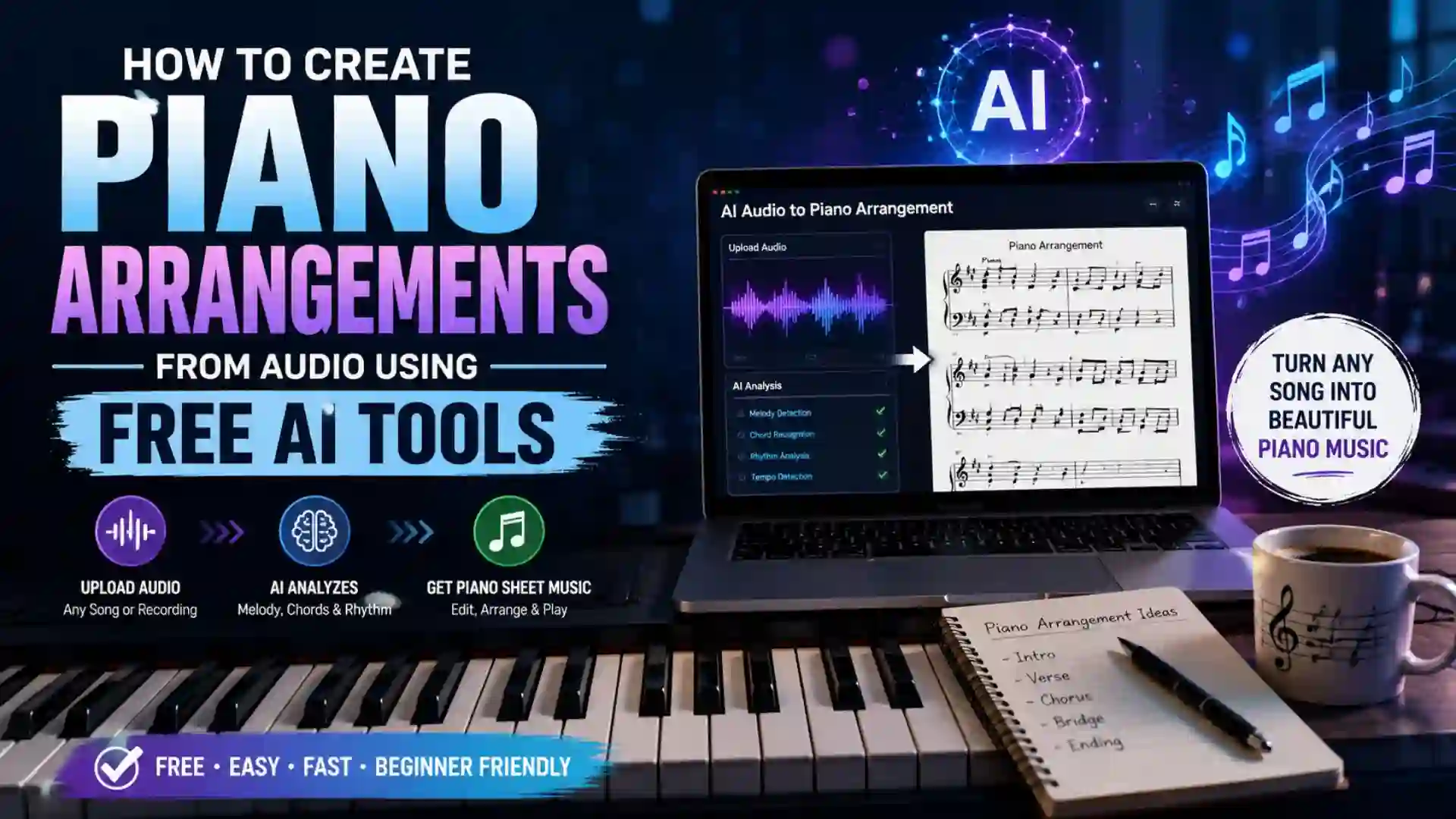
Creating Piano Arrangement from Audio AI Free: The rise of artificial intelligence has transformed the way musicians create, learn, and arrange music. One of the most exciting developments is the ability to create piano arrangements directly from audio recordings using free AI-powered tools. Whether you have a favorite song, a vocal recording, an instrumental track, or a live performance, AI can help convert that audio into a playable piano arrangement with minimal effort.
For music students, piano enthusiasts, composers, arrangers, and content creators, free AI tools have opened up opportunities that once required advanced music theory knowledge and hours of manual transcription. Today, AI can analyze melodies, identify chords, detect rhythms, and generate sheet music or MIDI files that can be adapted into piano arrangements.
This guide explains everything you need to know about creating piano arrangements from audio using free AI solutions, including workflows, benefits, challenges, best practices, and frequently asked questions.
What Is a Piano Arrangement?
A piano arrangement is a version of a musical piece adapted specifically for piano performance. The arrangement may preserve the original melody while adding harmony, bass lines, accompaniment patterns, and expressive elements suitable for piano.
Unlike simple transcriptions, piano arrangements often involve artistic decisions such as:
- Simplifying complex passages
- Enhancing harmonies
- Creating left-hand accompaniment
- Adjusting difficulty levels
- Adapting orchestral or vocal music for piano
AI tools can significantly speed up this process by extracting musical information from audio recordings.
Understanding Audio-to-Piano AI Technology
Audio-to-piano AI systems use machine learning algorithms to analyze recordings and identify musical components.
These systems typically perform several tasks:
Pitch Detection
The AI identifies individual notes played in the recording.
Chord Recognition
It analyzes harmonic structures and determines chord progressions.
Rhythm Analysis
The software identifies timing, tempo, and note durations.
Instrument Separation
Some advanced tools isolate vocals, drums, bass, and melody from mixed recordings.
MIDI Generation
The extracted musical information is converted into MIDI format, which can then be edited and arranged for piano.
The result is a foundation that musicians can refine into a polished piano arrangement.
Why Use AI for Piano Arrangements?
AI offers numerous advantages for musicians of all skill levels.
Time Savings
Traditional transcription may take several hours or even days. AI can produce a preliminary arrangement within minutes.
Accessibility
Beginners without extensive music theory knowledge can create arrangements more easily.
Learning Tool
Students can study how songs are structured and improve their understanding of harmony and melody.
Creative Inspiration
AI-generated arrangements often provide ideas that musicians may not have considered.
Cost Efficiency
Many free tools provide valuable features without requiring expensive software subscriptions.
Important Information and Useful Resources
| Resource Type | Purpose | Typical Output |
|---|---|---|
| Audio-to-MIDI Converter | Converts recordings into MIDI data | MIDI Files |
| AI Music Transcription Tool | Detects notes and chords | Sheet Music |
| Piano Roll Editor | Edits extracted notes | Custom Arrangement |
| DAW Software | Music production and editing | Audio and MIDI |
| Sheet Music Generator | Creates printable notation | PDF Scores |
| Instrument Separator | Isolates melody and accompaniment | Audio Stems |
| Tempo Detection Tool | Identifies song tempo | BPM Information |
| Chord Recognition Tool | Finds chord progressions | Chord Charts |
| MIDI Editor | Refines arrangement details | Performance-Ready MIDI |
| Music Notation Software | Produces professional sheet music | Piano Scores |
Step-by-Step Process for Creating Piano Arrangements from Audio
Step 1: Obtain a High-Quality Audio File
The quality of the source recording directly impacts AI accuracy.
Ideal sources include:
- Studio recordings
- Instrumental tracks
- High-quality MP3 files
- WAV recordings
- Clean vocal recordings
Avoid:
- Excessive background noise
- Distorted audio
- Poor-quality live recordings
Step 2: Upload Audio to an AI Tool
Most AI transcription platforms allow users to upload audio files directly.
The software begins analyzing:
- Melody
- Harmony
- Tempo
- Instrumentation
The processing time depends on the length and complexity of the recording.
Step 3: Generate MIDI or Sheet Music
After analysis, the AI generates:
- MIDI files
- Music notation
- Chord progressions
- Piano roll representations
MIDI is often the most flexible format because it allows extensive editing.
Step 4: Import into a Music Editor
Once generated, import the file into:
- Digital Audio Workstations (DAWs)
- MIDI editors
- Notation software
This stage allows detailed customization.
Step 5: Build the Piano Arrangement
Transform the extracted musical information into a complete piano performance.
Focus on:
- Right-hand melody
- Left-hand bass patterns
- Chord voicings
- Dynamics
- Musical expression
Step 6: Simplify or Enhance
Depending on the target audience, the arrangement can be:
Beginner-Friendly
- Simple chords
- Limited hand movement
- Reduced complexity
Intermediate
- Full harmonies
- Moderate accompaniment patterns
Advanced
- Rich textures
- Extended chords
- Virtuosic passages
Step 7: Final Review
Always review the AI output manually.
Check for:
- Incorrect notes
- Missing chords
- Rhythm inaccuracies
- Awkward fingerings
Human refinement remains essential for professional-quality results.
Features to Look for in Free AI Tools
Not all AI music applications are equally capable.
Important features include:
Automatic Transcription
Converts audio into notation.
Chord Detection
Recognizes harmonic structures.
MIDI Export
Allows flexible editing.
Tempo Detection
Identifies BPM automatically.
Multi-Instrument Recognition
Separates instruments for clearer transcription.
Sheet Music Generation
Creates readable notation.
Cloud Processing
Handles complex audio without requiring powerful hardware.
Common Challenges and Solutions
Polyphonic Audio
Songs with multiple instruments can confuse AI.
Solution:
Use stem separation before transcription.
Complex Rhythms
Jazz and progressive music may produce inaccurate results.
Solution:
Manually correct rhythm values after conversion.
Dense Arrangements
Orchestral recordings often contain overlapping frequencies.
Solution:
Isolate melody and harmony tracks separately.
Audio Quality Problems
Poor recordings reduce transcription accuracy.
Solution:
Use the highest-quality source available.
Best Practices for Better Results
Choose Clean Audio
Clear recordings produce better transcriptions.
Use Instrumental Versions
Removing vocals often improves note detection.
Edit MIDI Manually
AI provides a starting point, not a finished arrangement.
Understand Basic Music Theory
Knowledge of chords and scales helps refine AI outputs.
Save Multiple Versions
Keep original and edited files separately.
Verify Chords
Always check harmonic progressions manually.
Creating Different Types of Piano Arrangements
Solo Piano Arrangement
The most common format.
Includes:
- Melody
- Harmony
- Bass accompaniment
Piano Accompaniment
Designed to support singers or instrumentalists.
Focuses on:
- Chords
- Rhythmic support
- Minimal melodic content
Piano Cover
A faithful adaptation of the original song.
Preserves:
- Main melody
- Original harmonies
- Song structure
Piano Interpretation
A creative reimagining of the source material.
Allows:
- New harmonies
- Modified rhythms
- Personal artistic expression
Benefits for Music Students
Students can use AI-generated arrangements to:
- Learn songs faster
- Study harmony
- Practice sight-reading
- Understand chord progressions
- Improve arranging skills
Rather than replacing learning, AI can accelerate musical education.
Benefits for Content Creators
Content creators often need background music quickly.
AI-assisted piano arrangements help with:
- YouTube videos
- Podcasts
- Online courses
- Social media content
- Educational materials
By adapting existing recordings into piano versions, creators can develop unique musical content more efficiently.
Ethical and Copyright Considerations
When creating arrangements from copyrighted music, users should understand intellectual property rules.
Important considerations include:
Personal Use
Usually acceptable for practice and education.
Commercial Use
May require permission from copyright holders.
Public Distribution
Publishing arrangements can involve licensing obligations.
Derivative Works
Many jurisdictions treat arrangements as derivative creations.
Always review local copyright regulations before distributing arrangements publicly.
Future of AI-Powered Piano Arranging
AI music technology continues to evolve rapidly.
Future developments may include:
- Near-perfect transcription accuracy
- Real-time arrangement generation
- Style-specific arranging
- Personalized difficulty adjustments
- Interactive piano tutoring
- Automatic orchestration and reharmonization
As machine learning models improve, musicians will gain even more powerful tools for creativity and productivity.
Human Creativity Still Matters
Despite impressive advances, AI cannot fully replace human musical judgment.
Successful arrangements depend on:
- Emotional interpretation
- Artistic expression
- Performance considerations
- Musical taste
- Creative decision-making
The most effective workflow combines AI efficiency with human expertise.
FAQ about Creating Piano Arrangement from Audio AI Free
Can AI really convert audio into a piano arrangement?
Yes. Modern AI systems can analyze recordings, identify notes and chords, and generate MIDI or sheet music that serves as the basis for a piano arrangement.
Are free AI tools accurate?
Many free tools provide surprisingly good results, especially with clear recordings. However, manual corrections are often necessary.
Do I need music theory knowledge?
Basic music theory helps improve the final arrangement, but beginners can still create useful piano versions using AI assistance.
Can AI arrange songs from YouTube recordings?
If the audio quality is sufficient, AI can often analyze and transcribe music from recordings obtained from various sources.
What file format is best for editing?
MIDI is generally the most flexible format because notes, timing, and dynamics can be edited easily.
Can AI detect chords automatically?
Yes. Most modern transcription tools include chord recognition features.
Is AI transcription suitable for classical music?
It can work for classical music, but complex polyphonic passages may require significant manual editing.
Can beginners create piano covers using AI?
Absolutely. AI lowers the barrier to entry and helps beginners create arrangements more quickly.
Does AI replace professional arrangers?
No. Professional arrangers provide artistic interpretation and musical expertise that AI cannot fully replicate.
Can I publish AI-generated piano arrangements?
Publication may involve copyright considerations depending on the source material and jurisdiction.
Conclusion
Creating piano arrangements from audio using free AI tools has become one of the most exciting developments in modern music technology. What once required advanced transcription skills, extensive musical training, and countless hours of manual work can now be initiated within minutes through intelligent audio analysis systems.
AI can identify melodies, recognize chords, generate MIDI files, create sheet music, and provide a solid foundation for piano arrangements. These capabilities benefit beginners, students, educators, content creators, composers, and professional musicians alike. However, the best results still come from combining AI-generated output with human creativity, musical understanding, and careful editing.
Whether you want to learn your favorite songs, create educational resources, produce content for online platforms, or explore new arranging techniques, free AI-powered audio-to-piano workflows offer a practical and accessible solution. As the technology continues to evolve, musicians will gain even more powerful tools to transform audio recordings into expressive, playable, and inspiring piano arrangements.