
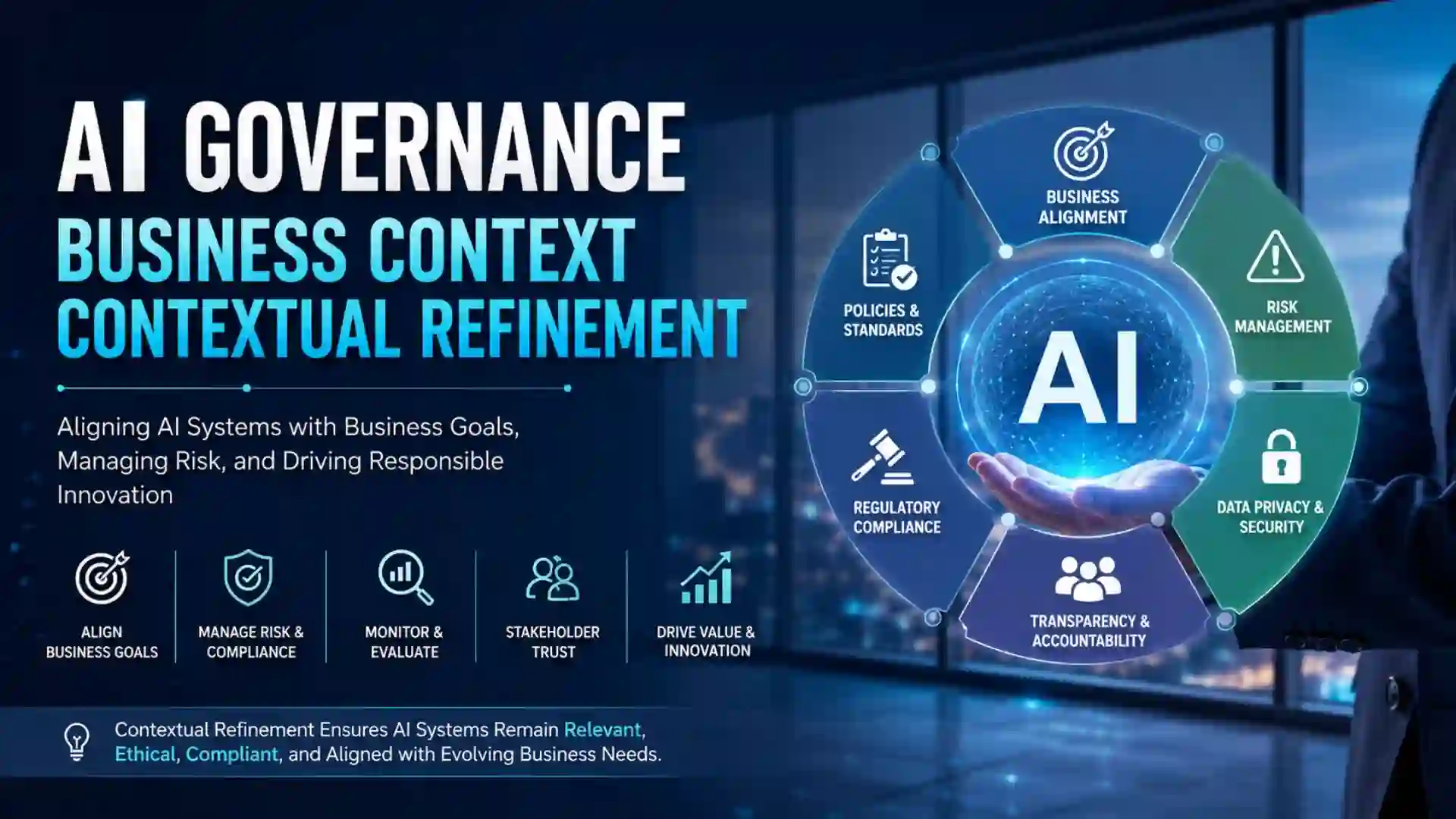
AI Governance Business Context Contextual Refinement: Artificial Intelligence has rapidly become a critical component of modern business operations. Organizations across industries are using AI to automate processes, improve customer experiences, enhance decision-making, and create innovative products and services. However, as AI systems become more influential, the need for effective governance has become increasingly important. One of the most significant aspects of modern AI governance is business context contextual refinement.
AI governance business context contextual refinement refers to the process of continuously improving AI systems by aligning them with business objectives, organizational values, regulatory requirements, operational realities, and stakeholder expectations. It ensures that AI systems operate within the appropriate context and deliver outcomes that support strategic goals while minimizing risks.
This article explores the concept of AI governance business context contextual refinement, its importance, implementation strategies, benefits, challenges, and future developments.
Important Information and Links
| Information | Details |
|---|---|
| Topic | AI Governance Business Context Contextual Refinement |
| Primary Goal | Align AI systems with business objectives and governance requirements |
| Key Focus Areas | Compliance, Risk Management, Ethics, Transparency, Accountability |
| Business Benefits | Better decision-making, improved trust, reduced risk |
| Governance Components | Policies, Monitoring, Auditing, Human Oversight |
| Stakeholders | Executives, Data Scientists, Compliance Teams, Customers |
| AI Lifecycle Stages | Design, Development, Deployment, Monitoring, Improvement |
| Risk Areas | Bias, Security, Privacy, Compliance Violations |
| Success Metrics | Accuracy, Fairness, Explainability, Business Value |
| Future Direction | Adaptive Governance and Context-Aware AI Systems |
Understanding AI Governance
AI governance refers to the framework of policies, processes, standards, and controls that guide the development and use of artificial intelligence within an organization. Governance ensures that AI systems remain ethical, transparent, secure, accountable, and compliant with applicable regulations.
Organizations often invest significant resources in AI development but fail to establish proper governance mechanisms. Without governance, AI systems can create unintended consequences, including biased decisions, privacy violations, security vulnerabilities, and reputational damage.
AI governance helps organizations answer critical questions such as:
- Is the AI system aligned with business goals?
- Are decisions transparent and explainable?
- Does the system comply with regulations?
- Are risks properly managed?
- Is human oversight maintained?
Business context contextual refinement plays a vital role in answering these questions throughout the AI lifecycle.
What is Business Context Contextual Refinement?
Business context contextual refinement is the ongoing process of updating and optimizing AI systems based on changing business environments, organizational priorities, customer needs, market conditions, and regulatory expectations.
Traditional AI models are often trained using historical data and deployed with limited consideration for evolving business realities. Over time, changes in business conditions may reduce model effectiveness or create governance concerns.
Contextual refinement addresses this issue by continuously evaluating whether AI outputs remain relevant, accurate, ethical, and aligned with organizational objectives.
This process includes:
- Understanding business goals.
- Evaluating operational environments.
- Incorporating stakeholder feedback.
- Monitoring performance metrics.
- Adjusting AI behavior based on changing circumstances.
- Ensuring ongoing regulatory compliance.
The objective is to create AI systems that remain contextually aware and business-aligned throughout their operational lifespan.
Why Context Matters in AI Governance?
AI systems do not operate in isolation. They function within complex business ecosystems involving customers, employees, regulators, partners, and technologies.
A recommendation engine used by an e-commerce company, for example, must consider customer preferences, inventory levels, marketing strategies, legal requirements, and company values. If any of these factors change, the AI system may require refinement.
Without proper contextual understanding, AI systems can generate outcomes that are technically accurate but strategically inappropriate.
For example:
- A lending AI may approve risky loans if economic conditions change.
- A hiring AI may unintentionally reinforce outdated workforce patterns.
- A customer service chatbot may provide responses inconsistent with new company policies.
Business context contextual refinement ensures that AI systems adapt to these changing realities.
Key Components of Contextual Refinement
Business Objective Alignment
AI systems should directly support organizational goals. Governance teams must regularly assess whether AI outcomes contribute to desired business results.
Questions to consider include:
- Does the system improve operational efficiency?
- Does it support customer satisfaction goals?
- Is it generating measurable business value?
- Are outputs aligned with strategic priorities?
Regular reviews help maintain alignment between AI capabilities and organizational objectives.
Regulatory Compliance
Regulatory environments are evolving rapidly. Governments worldwide are introducing new AI regulations focusing on transparency, accountability, fairness, and privacy.
Contextual refinement requires organizations to continuously evaluate AI systems against current legal requirements.
Areas requiring attention include:
- Data privacy laws.
- Consumer protection regulations.
- Industry-specific compliance standards.
- AI transparency requirements.
- Cross-border data governance rules.
Compliance monitoring should be integrated into governance frameworks.
Risk Assessment
Risk management is a central component of AI governance.
Organizations must continuously identify, evaluate, and mitigate risks associated with AI deployment.
Common risk categories include:
- Algorithmic bias.
- Security vulnerabilities.
- Model drift.
- Data quality issues.
- Reputational risks.
- Ethical concerns.
Contextual refinement ensures that emerging risks are detected early and addressed proactively.
Stakeholder Engagement
Effective governance requires input from multiple stakeholders.
These may include:
- Executive leadership.
- Business managers.
- Legal teams.
- Compliance officers.
- Data scientists.
- Customers.
- Employees.
Stakeholder feedback helps organizations understand whether AI systems are meeting expectations and operating responsibly.
Performance Monitoring
Continuous monitoring allows organizations to identify performance degradation and contextual mismatches.
Key performance indicators may include:
- Accuracy.
- Precision.
- Recall.
- Customer satisfaction.
- Fairness metrics.
- Business outcomes.
- Operational efficiency.
Monitoring supports informed decision-making regarding model updates and governance interventions.
The Role of Contextual Intelligence
Contextual intelligence refers to an AI system’s ability to interpret information within a broader business environment rather than relying solely on historical patterns.
Organizations increasingly recognize that technical accuracy alone is insufficient.
An AI model may achieve high predictive accuracy while still making decisions that conflict with organizational values or market realities.
Contextual intelligence enables AI systems to consider:
- Industry trends.
- Organizational priorities.
- Customer expectations.
- Economic conditions.
- Regulatory changes.
- Ethical considerations.
This capability significantly enhances governance effectiveness.
AI Lifecycle and Contextual Refinement
Planning Phase
Governance begins before model development.
Organizations should define:
- Business objectives.
- Success criteria.
- Risk tolerance levels.
- Ethical principles.
- Compliance requirements.
Clear planning establishes a strong foundation for contextual refinement.
Development Phase
During development, teams should ensure that:
- Training data reflects business realities.
- Bias testing is performed.
- Explainability mechanisms are incorporated.
- Governance controls are implemented.
Development decisions influence long-term governance effectiveness.
Deployment Phase
Deployment introduces AI systems into real-world environments.
Organizations should validate:
- Operational readiness.
- Risk controls.
- Monitoring mechanisms.
- Human oversight procedures.
Deployment reviews help identify contextual issues before widespread implementation.
Operational Phase
Once deployed, AI systems require continuous observation.
Organizations should monitor:
- Performance trends.
- Business outcomes.
- User feedback.
- Regulatory developments.
- Risk indicators.
Operational monitoring forms the core of contextual refinement.
Improvement Phase
Insights gained through monitoring should drive system improvements.
This may involve:
- Model retraining.
- Policy updates.
- Data enhancements.
- Governance adjustments.
- Process optimization.
Continuous improvement ensures long-term effectiveness.
Benefits of Business Context Contextual Refinement
Enhanced Decision Quality
AI systems that understand business context generate more relevant and actionable insights.
Decision-makers receive recommendations that align with organizational objectives and operational realities.
Improved Compliance
Continuous contextual evaluation helps organizations stay aligned with changing regulations.
This reduces the likelihood of compliance violations and associated penalties.
Reduced Risk
Refinement processes identify potential issues before they become significant problems.
Organizations can proactively address risks related to bias, privacy, security, and operational performance.
Greater Trust
Stakeholders are more likely to trust AI systems that demonstrate transparency, accountability, and contextual awareness.
Trust is essential for successful AI adoption.
Increased Business Value
AI systems that remain aligned with business goals generate stronger returns on investment.
Organizations can maximize value while minimizing governance-related challenges.
Challenges in Contextual Refinement
Rapidly Changing Environments
Business environments evolve quickly.
Organizations must continually monitor market conditions, customer behavior, and regulatory developments.
Keeping AI systems aligned with these changes requires significant effort.
Data Complexity
Modern organizations generate vast amounts of data from diverse sources.
Ensuring data quality and contextual relevance can be difficult.
Poor data quality undermines governance effectiveness.
Resource Constraints
Contextual refinement requires skilled personnel, governance frameworks, monitoring tools, and executive support.
Smaller organizations may struggle to allocate sufficient resources.
Regulatory Uncertainty
AI regulations continue to evolve globally.
Organizations must remain informed about emerging requirements and adjust governance practices accordingly.
Balancing Innovation and Control
Excessive governance can slow innovation, while insufficient governance increases risk.
Organizations must find an appropriate balance between flexibility and oversight.
Best Practices for Implementation
Establish Clear Governance Structures
Organizations should define roles and responsibilities for AI governance.
Governance committees, risk teams, and executive sponsors should collaborate to ensure accountability.
Develop Context-Aware Policies
Policies should address:
- Ethical AI use.
- Data management.
- Transparency.
- Accountability.
- Monitoring requirements.
Policies should reflect organizational values and business objectives.
Implement Continuous Monitoring
Monitoring should occur throughout the AI lifecycle.
Automated monitoring systems can identify anomalies, performance issues, and governance concerns in real time.
Maintain Human Oversight
Human judgment remains essential.
Organizations should ensure that critical decisions involve appropriate human review and intervention capabilities.
Conduct Regular Audits
Independent audits help evaluate governance effectiveness and identify improvement opportunities.
Audit findings should inform refinement activities.
Promote Cross-Functional Collaboration
Successful contextual refinement requires collaboration among technical, business, legal, and compliance teams.
Cross-functional perspectives improve governance quality.
Future Trends in AI Governance Contextual Refinement
Several emerging trends are shaping the future of AI governance.
Adaptive Governance Frameworks
Organizations are moving toward governance models that can dynamically adjust to changing business conditions and regulatory requirements.
Explainable AI
Greater emphasis is being placed on understanding how AI systems make decisions.
Explainability supports accountability and stakeholder trust.
Real-Time Risk Monitoring
Advanced monitoring tools are enabling organizations to identify risks as they emerge.
Real-time governance capabilities will become increasingly important.
Context-Aware AI Systems
Future AI systems will possess stronger contextual understanding, allowing them to adapt more effectively to changing environments.
Integrated Governance Platforms
Organizations are adopting centralized governance platforms that combine monitoring, compliance, auditing, and risk management functions.
These platforms simplify governance operations and improve oversight.
Building a Sustainable AI Governance Strategy
A sustainable AI governance strategy requires long-term commitment from leadership and stakeholders.
Organizations should focus on:
- Strategic alignment.
- Ethical responsibility.
- Regulatory compliance.
- Continuous learning.
- Stakeholder engagement.
- Risk management.
Business context contextual refinement should be treated as an ongoing process rather than a one-time initiative.
Successful organizations recognize that governance is not merely a compliance requirement. It is a strategic capability that enables responsible innovation and sustainable growth.
FAQ about AI Governance Business Context Contextual Refinement
What is AI governance business context contextual refinement?
It is the process of continuously aligning AI systems with business goals, operational environments, regulatory requirements, and stakeholder expectations to ensure responsible and effective performance.
Why is contextual refinement important for AI governance?
Contextual refinement helps maintain AI relevance, reduce risks, improve compliance, enhance decision quality, and ensure alignment with changing business conditions.
What are the main components of contextual refinement?
Key components include business objective alignment, compliance management, risk assessment, stakeholder engagement, performance monitoring, and continuous improvement.
How does contextual refinement reduce AI risks?
It enables organizations to identify issues such as bias, model drift, privacy concerns, and compliance gaps early, allowing proactive corrective action.
Who should be involved in AI governance?
Executives, business leaders, data scientists, compliance professionals, legal teams, risk managers, and other stakeholders should participate in governance activities.
What challenges do organizations face in contextual refinement?
Common challenges include rapidly changing business environments, evolving regulations, data complexity, limited resources, and balancing innovation with governance controls.
How often should AI systems be reviewed?
Review frequency depends on risk levels and business requirements, but continuous monitoring and periodic governance assessments are generally recommended.
What is the future of AI governance contextual refinement?
The future includes adaptive governance frameworks, real-time risk monitoring, explainable AI, context-aware systems, and integrated governance platforms that support ongoing oversight and improvement.
Conclusion
AI governance business context contextual refinement has become a critical requirement for organizations seeking to deploy AI responsibly and effectively. As business environments, regulations, and stakeholder expectations continue to evolve, AI systems must adapt to remain relevant and trustworthy.
By continuously aligning AI systems with organizational objectives, operational realities, ethical principles, and regulatory requirements, businesses can maximize the value of artificial intelligence while minimizing associated risks. Effective contextual refinement improves decision quality, enhances compliance, strengthens stakeholder trust, and supports sustainable innovation.
Organizations that invest in robust governance frameworks, continuous monitoring, stakeholder engagement, and adaptive refinement processes will be better positioned to succeed in the increasingly AI-driven business landscape. Rather than viewing governance as a limitation, forward-thinking organizations will recognize it as a foundation for responsible and scalable AI adoption.