
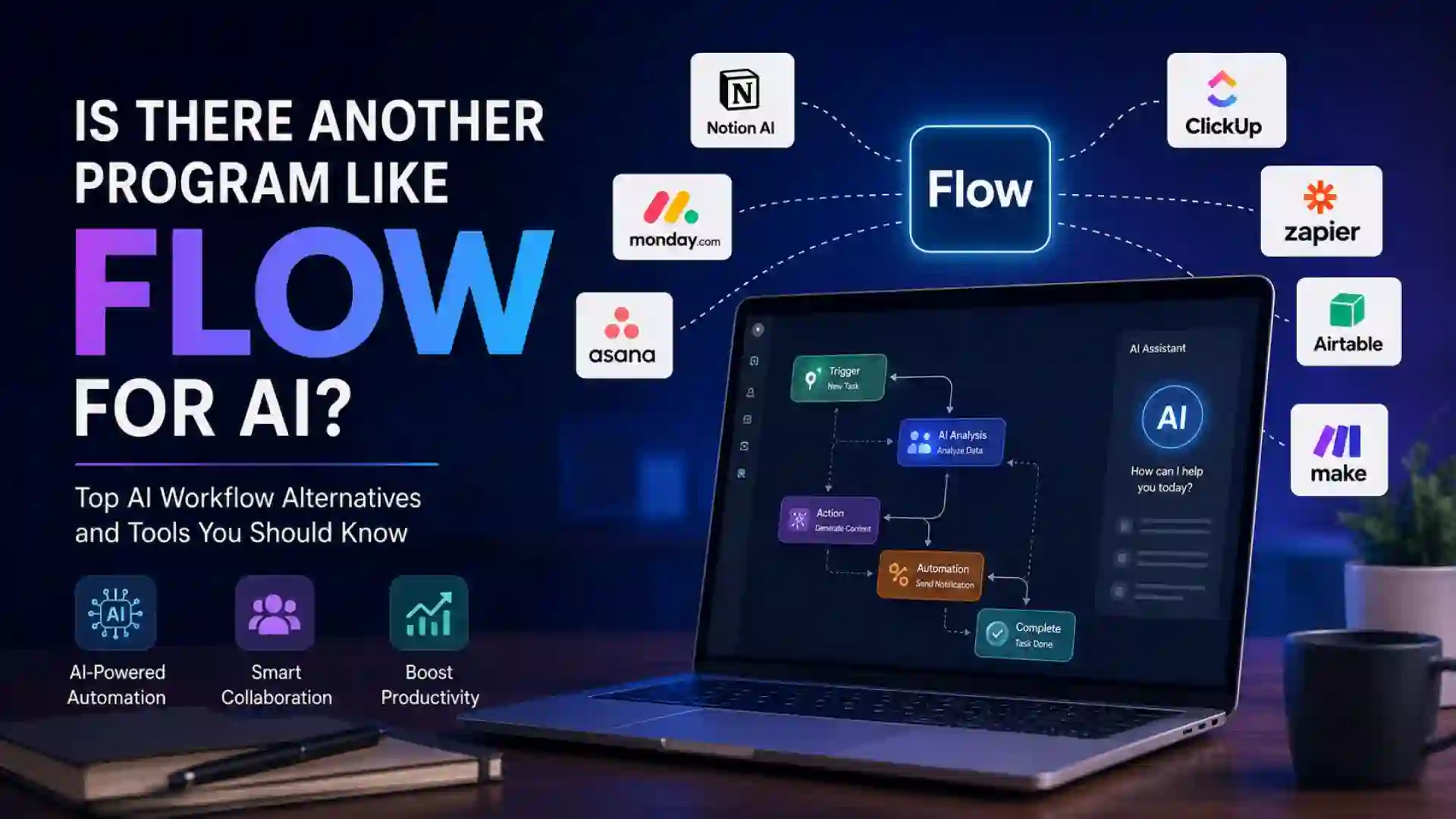
Is There Another Program Like Flow for AI? Artificial intelligence tools have rapidly transformed the way individuals and businesses work. Among the many AI-powered platforms available today, Flow has gained attention for helping users organize, automate, and streamline workflows with AI assistance. However, many users eventually ask the same question: Is there another program like Flow for AI?
The short answer is yes. There are numerous AI workflow platforms and automation tools that provide features similar to Flow. Some focus on automation, others emphasize collaboration, while some specialize in AI-powered task management, content generation, or business process optimization.
Whether you are a business owner, marketer, developer, content creator, or project manager, understanding the alternatives available can help you choose a solution that better matches your needs and budget.
In this guide, we will explore what makes Flow popular, why users seek alternatives, and which AI-powered programs offer comparable or even superior functionality.
What Is Flow for AI?
Flow is generally recognized as a workflow management and automation platform that incorporates AI capabilities to help users improve productivity. Depending on the version or product being referenced, Flow may assist with:
- Task management
- Workflow automation
- Team collaboration
- AI-powered recommendations
- Process optimization
- Data organization
- Content generation
- Project tracking
The main goal of AI workflow software is to reduce manual work and allow teams to focus on higher-value activities.
As AI technology evolves, many competing platforms have entered the market with similar goals but different approaches.
Why Do Users Look for Alternatives to Flow?
Several factors motivate users to explore other AI workflow solutions.
Cost Concerns
Many organizations operate with limited budgets. If Flow pricing becomes restrictive, businesses often search for alternatives offering similar functionality at a lower cost.
Different Feature Requirements
Not every organization needs the same tools. Some users prioritize automation, while others need advanced collaboration, analytics, or AI-generated content.
Scalability
Growing businesses may outgrow their original software and require platforms capable of handling larger teams and more complex workflows.
Integration Needs
Companies often rely on multiple applications. A workflow tool that integrates seamlessly with existing systems can significantly improve efficiency.
User Experience
Ease of use matters. Some teams prefer simpler interfaces, while others need highly customizable environments.
Important Programs Similar to Flow
The following table highlights some of the most notable alternatives to Flow.
| Program | Primary Purpose | AI Features | Best For |
|---|---|---|---|
| Notion AI | Workspace and documentation | AI writing, summarization, brainstorming | Teams and content creators |
| ClickUp | Project management | AI task assistance and writing | Businesses and project teams |
| Monday.com | Workflow management | AI automation and analytics | Large organizations |
| Asana | Task management | AI workflow recommendations | Team collaboration |
| Trello | Visual project tracking | AI-powered productivity tools | Small teams |
| Zapier | Workflow automation | AI automation builder | Process automation |
| Airtable | Database management | AI data processing | Operations teams |
| Make | Advanced automation | AI-enhanced workflow creation | Technical users |
| Smartsheet | Project and resource management | AI insights | Enterprise users |
| Wrike | Work management | AI-powered planning | Marketing and operations teams |
Notion AI
Notion AI has become one of the most popular productivity tools available today.
The platform combines note-taking, project management, documentation, and AI-powered assistance into a single workspace.
Key strengths include:
- Content generation
- Meeting summaries
- Knowledge management
- Project tracking
- Collaborative workspaces
Many users who appreciate Flow’s organizational capabilities find Notion AI to be a compelling alternative.
Its ability to generate text, summarize documents, and help organize information makes it especially valuable for remote teams.
ClickUp
ClickUp positions itself as an all-in-one productivity platform.
It combines:
- Task management
- Goal tracking
- Team collaboration
- Document creation
- AI assistance
The AI features help users create content, summarize information, generate ideas, and improve project planning.
For businesses looking for a highly customizable solution, ClickUp offers flexibility that rivals many workflow platforms.
One reason companies choose ClickUp over Flow is the ability to manage nearly every aspect of operations from a single dashboard.
Monday.com
Monday.com has evolved from a simple project management tool into a comprehensive work operating system.
The platform uses AI to:
- Automate repetitive tasks
- Generate workflow suggestions
- Analyze project performance
- Improve resource allocation
Organizations with complex workflows often prefer Monday.com because of its scalability.
The visual interface allows teams to monitor progress across departments while benefiting from AI-powered automation.
Asana
Asana remains one of the most recognized project management solutions worldwide.
Its AI capabilities focus on:
- Workflow optimization
- Smart task prioritization
- Automated updates
- Project recommendations
Asana excels in team collaboration and visibility.
Managers can track assignments, deadlines, and dependencies while AI assists with identifying bottlenecks before they become major issues.
For organizations focused heavily on teamwork, Asana is often considered a strong Flow alternative.
Trello
Trello uses a visual board system that simplifies project management.
Although originally known for its simplicity, Trello has expanded its AI functionality through integrations and built-in features.
Benefits include:
- Visual task organization
- Automated workflows
- AI-powered productivity enhancements
- Easy onboarding
Smaller businesses and startups often choose Trello because team members can learn the platform quickly.
For users seeking a less complex alternative to Flow, Trello may be an excellent option.
Zapier
Zapier differs from traditional project management platforms because its primary focus is automation.
The software connects thousands of applications and automates repetitive actions between them.
Examples include:
- Automatically sending emails
- Updating spreadsheets
- Creating CRM records
- Synchronizing customer data
Recent AI additions allow users to build automations using natural language instructions.
For businesses wanting to eliminate repetitive administrative work, Zapier can often outperform conventional workflow tools.
Airtable
Airtable combines database functionality with workflow management.
Its AI capabilities help users:
- Analyze records
- Generate content
- Organize information
- Improve reporting
Many organizations use Airtable as a flexible alternative to spreadsheets.
Because workflows can be customized extensively, Airtable appeals to teams that require both structure and adaptability.
Companies managing large datasets often find Airtable more powerful than standard workflow platforms.
Make
Make, formerly known as Integromat, focuses on advanced workflow automation.
Compared to many competitors, Make offers greater visual control over automation processes.
Features include:
- Complex workflow design
- AI integrations
- Data transformations
- Application connectivity
Technical users often prefer Make because it allows highly sophisticated automations without requiring extensive programming knowledge.
For organizations seeking maximum workflow flexibility, Make is frequently considered one of the strongest alternatives available.
Smartsheet
Smartsheet combines project management with spreadsheet-style functionality.
AI features support:
- Resource forecasting
- Project analysis
- Risk assessment
- Performance monitoring
Large enterprises frequently adopt Smartsheet because it supports complex operational environments.
The platform helps managers coordinate large teams while maintaining visibility into project performance.
If your organization manages multiple departments or large-scale initiatives, Smartsheet deserves consideration.
Wrike
Wrike focuses on work management and operational efficiency.
Its AI functionality includes:
- Task prioritization
- Project planning
- Workload balancing
- Workflow optimization
Marketing teams often favor Wrike because it supports campaign management and creative collaboration.
Businesses seeking enterprise-level workflow control may find Wrike to be a powerful replacement for Flow.
Comparing Flow Alternatives by Use Case
Different users have different needs.
For Content Creators
Best options:
- Notion AI
- ClickUp
- Airtable
These platforms provide strong AI writing and content organization capabilities.
For Project Managers
Best options:
- Asana
- Monday.com
- Wrike
These solutions focus heavily on project tracking and team coordination.
For Automation
Best options:
- Zapier
- Make
Businesses looking to automate repetitive processes should consider these platforms first.
For Enterprise Organizations
Best options:
- Smartsheet
- Monday.com
- Wrike
These systems support large teams and complex operational requirements.
For Small Businesses
Best options:
- Trello
- Notion AI
- ClickUp
These platforms balance affordability with functionality.
Key Features to Look for in an AI Workflow Platform
Before choosing a Flow alternative, evaluate the following features.
AI Assistance
Look for tools capable of:
- Generating content
- Summarizing information
- Analyzing data
- Providing recommendations
Automation
Automation reduces repetitive work and improves efficiency.
The best platforms allow users to create workflows without extensive technical knowledge.
Integration Support
Verify that the platform connects with:
- Email systems
- CRM software
- Marketing tools
- Communication platforms
- Cloud storage services
Collaboration Tools
Effective teamwork requires:
- Shared workspaces
- Task assignments
- File sharing
- Communication features
Scalability
The platform should support future growth.
Migrating systems repeatedly can become expensive and disruptive.
Security
Organizations handling sensitive information should prioritize:
- Data encryption
- User permissions
- Compliance features
- Audit logs
Are AI Workflow Platforms Worth the Investment?
For many organizations, the answer is yes.
AI workflow tools can provide significant benefits:
- Reduced administrative workload
- Faster project completion
- Better team communication
- Improved accuracy
- Enhanced productivity
- Lower operational costs
The value depends on how effectively the software aligns with organizational goals.
Businesses that automate repetitive processes often see substantial efficiency gains.
Future of AI Workflow Software
The future of AI workflow platforms looks promising.
Several trends are expected to shape the market:
Greater Automation
AI systems will automate increasingly complex tasks.
Better Decision Support
Future platforms may provide predictive recommendations based on historical data.
Natural Language Workflow Creation
Users will increasingly create workflows simply by describing what they want in plain language.
Personalized AI Assistants
Workflow tools may include AI assistants that understand company processes and provide proactive support.
Cross-Platform Intelligence
Future solutions will likely connect data across multiple applications more intelligently than current systems.
As these innovations emerge, alternatives to Flow will continue becoming more powerful and accessible.
FAQ about Is There Another Program Like Flow for AI?
Is there another program like Flow for AI?
Yes. Popular alternatives include Notion AI, ClickUp, Monday.com, Asana, Trello, Zapier, Airtable, Make, Smartsheet, and Wrike.
Which Flow alternative is best for automation?
Zapier and Make are among the strongest options for workflow automation and application integration.
Which platform is best for content creation?
Notion AI and ClickUp provide robust AI writing and content management capabilities.
Is there a free alternative to Flow?
Several platforms offer free plans, including Trello, Notion AI, ClickUp, and Asana. However, advanced AI features may require paid subscriptions.
Which alternative is best for large organizations?
Monday.com, Smartsheet, and Wrike are commonly chosen by enterprises due to their scalability and advanced management features.
Can AI workflow tools replace employees?
AI workflow platforms are designed to assist employees rather than replace entire teams. They automate repetitive tasks and improve productivity while humans continue handling strategic and creative responsibilities.
How do I choose the right Flow alternative?
Consider your budget, team size, workflow complexity, integration requirements, and AI feature needs. Testing multiple platforms through free trials is often the best approach.
Conclusion
If you are wondering whether there is another program like Flow for AI, the answer is absolutely yes. The market now offers a wide range of AI-powered workflow solutions designed for different types of users and organizations.
Notion AI excels in knowledge management and content creation. ClickUp provides an all-in-one productivity environment. Monday.com and Asana focus on project coordination and team collaboration. Zapier and Make specialize in workflow automation, while Airtable combines database management with AI capabilities. Enterprise users may find Smartsheet and Wrike particularly attractive due to their scalability and advanced management tools.
The best choice ultimately depends on your specific goals. Organizations focused on automation may prioritize Zapier or Make, while content-driven teams might prefer Notion AI. Large enterprises often benefit from Monday.com, Wrike, or Smartsheet.
As artificial intelligence continues to evolve, workflow platforms will become increasingly intelligent, making it easier than ever to automate tasks, streamline operations, and improve productivity. Evaluating your needs carefully and selecting the right platform can help ensure long-term success in an increasingly AI-driven workplace.