
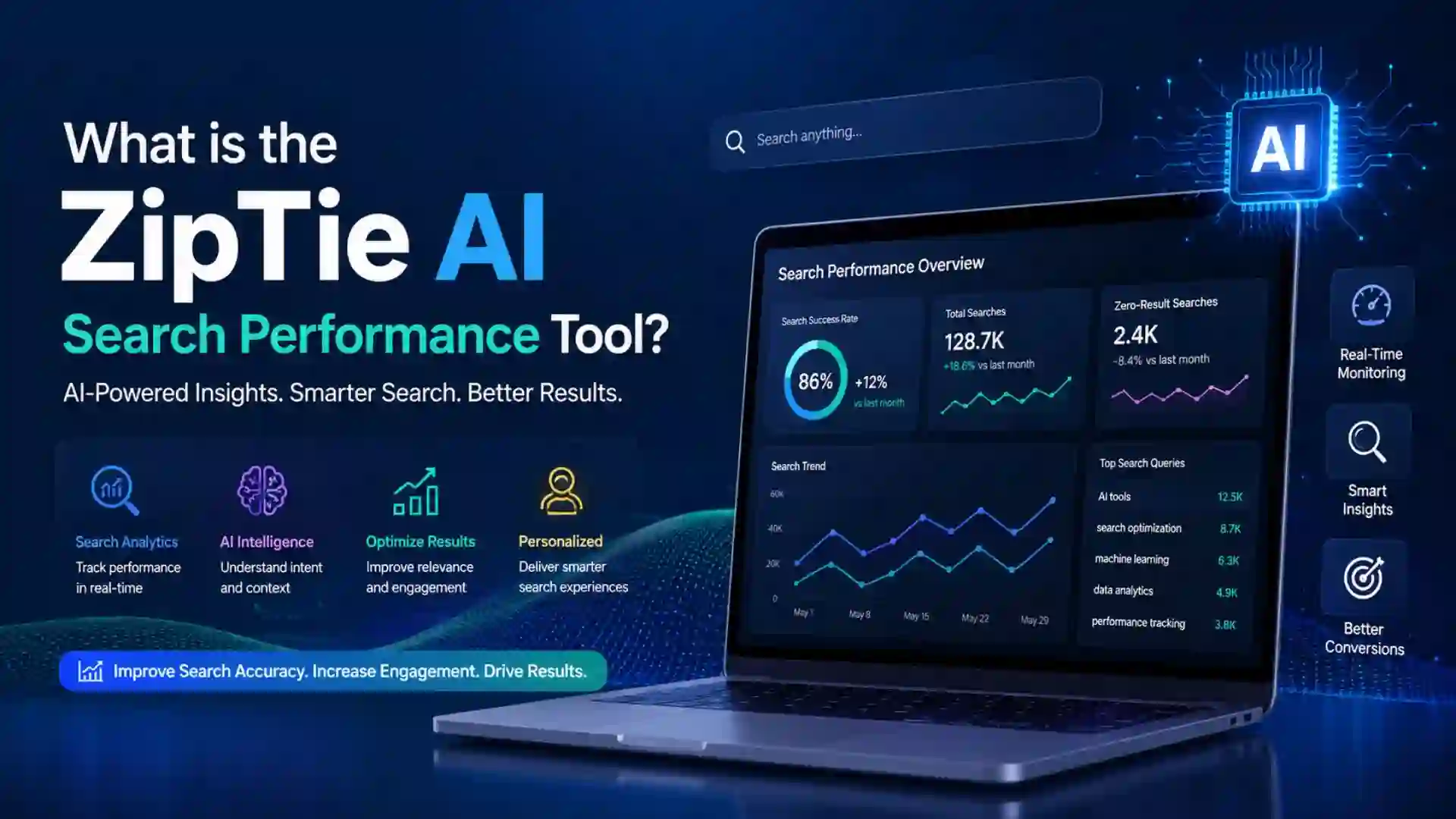
What Is the ZipTie AI Search Performance Tool? Search technology has changed dramatically over the last few years. Traditional keyword-based search systems are no longer enough for businesses that manage large volumes of data, digital assets, customer interactions, and enterprise workflows. Organizations now need intelligent systems that can understand intent, process natural language, deliver relevant results quickly, and continuously improve search experiences through machine learning.
This is where the ZipTie AI Search Performance Tool becomes important. It is designed to improve the effectiveness, speed, accuracy, and intelligence of search operations across websites, applications, enterprise platforms, and digital ecosystems. Instead of relying only on exact keyword matching, the tool uses artificial intelligence to analyze user behavior, search intent, engagement patterns, and content relevance.
The ZipTie AI Search Performance Tool helps businesses understand how users search, why searches succeed or fail, and how search systems can be optimized for better user satisfaction and business performance. Whether an organization operates an eCommerce platform, SaaS application, enterprise knowledge base, educational platform, or customer support portal, search quality directly affects productivity and user experience.
This article explains what the ZipTie AI Search Performance Tool is, how it works, its major features, benefits, use cases, implementation strategies, challenges, future trends, and frequently asked questions.
Introduction to AI-Powered Search Performance
Search is one of the most critical components of digital platforms. Users expect fast and highly relevant results. If a search system fails to provide useful results, users may leave the platform, abandon purchases, or lose trust in the service.
Traditional search systems usually depend on:
- Exact keyword matching
- Basic indexing
- Manual tagging
- Static ranking algorithms
- Limited contextual understanding
AI-powered search systems improve these limitations by introducing:
- Natural language processing
- Semantic search
- User intent recognition
- Context-aware recommendations
- Predictive analytics
- Personalized search results
The ZipTie AI Search Performance Tool focuses specifically on measuring and optimizing search quality. Instead of only functioning as a search engine, it acts as an intelligent analytics and optimization platform for search operations.
What Is the ZipTie AI Search Performance Tool?
The ZipTie AI Search Performance Tool is an AI-driven platform that analyzes, monitors, measures, and improves the performance of digital search systems. It evaluates how users interact with search functions and provides insights that help organizations optimize search relevance, speed, accuracy, and user engagement.
The tool combines machine learning algorithms, search analytics, behavioral analysis, and AI-based optimization techniques to identify problems and improve search experiences automatically.
Its primary goal is to ensure that users can quickly find the information, products, services, or documents they are searching for.
The tool may include capabilities such as:
- Search query analysis
- User behavior tracking
- AI relevance scoring
- Search success rate monitoring
- Zero-result query detection
- Content gap identification
- Search ranking optimization
- Predictive search suggestions
- Real-time performance monitoring
Organizations use the tool to improve both operational efficiency and customer satisfaction.
How the ZipTie AI Search Performance Tool Works?
The platform operates by collecting search-related data from websites, applications, databases, or enterprise systems. It then processes this data using artificial intelligence models.
The workflow generally includes the following stages:
Data Collection
The system gathers search-related information such as:
- User search queries
- Click-through rates
- Search response times
- Bounce rates
- Failed searches
- Session duration
- Conversion rates
- Navigation patterns
This data helps the AI system understand how users interact with search functions.
Query Understanding
The AI engine processes search queries using natural language processing (NLP). Instead of only matching keywords, the system interprets meaning and intent.
For example:
- “Cheap smartphones under 200 dollars”
- “Affordable mobile phones”
- “Budget Android devices”
These queries may be understood as having similar intent.
Behavioral Analysis
The tool studies user interactions after a search occurs. It tracks:
- Which results users click
- How long users stay on pages
- Whether users refine searches
- Whether searches lead to purchases or actions
This helps determine search quality.
Performance Evaluation
The AI system calculates metrics related to:
- Search accuracy
- Relevance quality
- User satisfaction
- Conversion impact
- Engagement levels
It identifies patterns associated with successful or unsuccessful searches.
Optimization Recommendations
Based on analysis, the tool may recommend:
- Content improvements
- Search ranking changes
- Metadata updates
- Better tagging structures
- Search synonym expansion
- User interface adjustments
Some advanced systems may even apply optimizations automatically.
Key Features of the ZipTie AI Search Performance Tool
AI-Powered Search Analytics
The platform provides deep analytics about how users interact with search systems.
This includes:
- Popular search terms
- Trending queries
- User intent patterns
- Failed searches
- Search abandonment rates
These insights help organizations improve content and search performance.
Semantic Search Intelligence
Semantic search allows the tool to understand context and meaning rather than only exact keywords.
For example, a search for:
- “Running shoes”
- “Jogging sneakers”
- “Athletic footwear”
may produce similar results based on semantic relationships.
Real-Time Monitoring
The tool continuously monitors search performance in real time.
This allows organizations to:
- Detect performance drops
- Identify broken search indexes
- Monitor traffic spikes
- Analyze emerging search trends
Real-time monitoring is especially important for large-scale digital platforms.
Predictive Search Optimization
AI models can predict what users are likely to search for and improve recommendations.
This may include:
- Auto-suggestions
- Personalized recommendations
- Search predictions
- Dynamic ranking adjustments
Predictive systems improve user engagement and search efficiency.
Zero-Result Detection
One of the most valuable features is identifying searches that produce no results.
The tool helps businesses understand:
- Missing content areas
- Product demand gaps
- Poor metadata structures
- User terminology mismatches
This allows organizations to improve content availability.
Personalization Capabilities
AI-driven personalization adapts search results based on user behavior.
Factors may include:
- Past searches
- Browsing history
- Purchase behavior
- Geographic location
- Device type
- User preferences
Personalized search experiences often increase conversions and customer satisfaction.
Search Speed Optimization
The tool may analyze infrastructure performance and identify factors affecting search speed.
It can help optimize:
- Indexing methods
- Query processing
- Database structures
- Caching systems
Fast search performance is essential for modern digital experiences.
Benefits of Using the ZipTie AI Search Performance Tool
Improved User Experience
Users expect fast and relevant search results. AI optimization improves satisfaction and reduces frustration.
A better search experience often leads to:
- Longer session durations
- Higher engagement
- Increased trust
- Improved retention
Increased Conversion Rates
For eCommerce platforms, effective search directly affects revenue.
Users who find products quickly are more likely to:
- Complete purchases
- Add items to carts
- Return for future shopping
AI search optimization can significantly increase sales performance.
Better Content Discovery
Large organizations often manage thousands or millions of documents.
The tool helps users discover:
- Knowledge base articles
- Research materials
- Training content
- Internal resources
This improves organizational productivity.
Reduced Search Failures
The platform identifies failed search patterns and recommends improvements.
Reducing failed searches helps businesses avoid:
- Lost customers
- Reduced engagement
- User frustration
- Support ticket increases
Enhanced Decision-Making
Search analytics provide valuable business intelligence.
Organizations can understand:
- Customer interests
- Product demand
- Emerging trends
- Information gaps
This data supports strategic planning.
Continuous Learning and Improvement
Machine learning systems continuously improve over time.
As more data becomes available, the AI becomes better at:
- Understanding intent
- Ranking results
- Predicting needs
- Personalizing experiences
Industries That Use AI Search Performance Tools
eCommerce
Online retailers use AI search tools to:
- Improve product discovery
- Increase sales conversions
- Recommend related products
- Personalize shopping experiences
Search quality directly impacts online retail revenue.
Enterprise Knowledge Management
Large organizations use search optimization tools to help employees find information quickly.
This includes:
- Policies
- Technical documents
- HR resources
- Internal reports
Efficient knowledge retrieval improves productivity.
Healthcare
Healthcare organizations use AI search systems to access:
- Patient records
- Medical research
- Treatment guidelines
- Clinical documentation
Search accuracy is critical in healthcare environments.
Education
Educational platforms use search optimization to improve access to:
- Courses
- Research papers
- Learning materials
- Digital libraries
AI-enhanced search improves learning experiences.
Customer Support
Support platforms rely on intelligent search for:
- FAQ retrieval
- Troubleshooting articles
- Ticket management
- Self-service support
Better search reduces support costs.
Media and Publishing
Publishers use AI search tools to organize and deliver:
- Articles
- Videos
- Archives
- Multimedia content
Semantic search improves content accessibility.
Important Information and Resource
| Topic | Description | Importance |
|---|---|---|
| Search Analytics | Tracks user search behavior and performance metrics | Helps improve search quality |
| Semantic Search | Understands user intent and contextual meaning | Improves relevance |
| NLP Technology | Processes natural language queries | Enables intelligent search |
| Personalization | Customizes results based on user behavior | Enhances user experience |
| Zero-Result Analysis | Detects failed searches | Identifies missing content |
| Predictive Search | Suggests queries and recommendations | Increases engagement |
| Real-Time Monitoring | Tracks live search system performance | Improves reliability |
| Search Speed Optimization | Enhances response time | Reduces user frustration |
| Behavioral Analytics | Studies user interactions after searches | Measures search effectiveness |
| Machine Learning | Continuously improves search intelligence | Enables adaptive optimization |
| Enterprise Search | Organizes internal organizational information | Improves productivity |
| eCommerce Search | Enhances product discovery | Increases conversions |
| AI Recommendations | Suggests relevant content or products | Improves engagement |
| Search Ranking Optimization | Improves result ordering | Enhances relevance |
| Data Insights | Provides strategic business intelligence | Supports decision-making |
Challenges of AI Search Performance Systems
Although AI-powered search systems offer many benefits, they also involve challenges.
Data Quality Issues
AI systems rely heavily on quality data.
Problems such as:
- Incomplete metadata
- Poor tagging
- Duplicate content
- Inconsistent formatting
can reduce search effectiveness.
Privacy Concerns
Personalized search systems often collect user behavior data.
Organizations must ensure compliance with:
- Data privacy regulations
- Security standards
- User consent requirements
Privacy protection is essential.
Complex Implementation
Integrating AI search systems into existing platforms may require:
- Technical expertise
- Infrastructure changes
- API integrations
- Search architecture redesign
Implementation can be resource-intensive.
Continuous Maintenance
AI systems require regular updates and monitoring.
Organizations must:
- Retrain models
- Update datasets
- Optimize indexes
- Monitor performance metrics
Continuous improvement is necessary.
Bias and Relevance Issues
AI systems may unintentionally introduce bias in search results.
Improperly trained models can produce:
- Irrelevant recommendations
- Unequal content visibility
- Ranking inaccuracies
Proper governance is important.
How Businesses Can Implement AI Search Optimization Successfully?
Define Clear Objectives
Organizations should first determine what they want to improve.
Examples include:
- Faster search response
- Better product discovery
- Reduced failed searches
- Improved employee productivity
Clear goals help guide implementation.
Analyze Existing Search Problems
Businesses should identify current weaknesses such as:
- Low click-through rates
- Poor conversions
- High bounce rates
- Slow search speed
Understanding existing issues improves optimization efforts.
Organize Content Properly
Content quality significantly affects search performance.
Organizations should improve:
- Metadata
- Tagging
- Categorization
- Structured data
Clean content structures support AI accuracy.
Monitor Search Metrics
Important metrics include:
- Search success rate
- User satisfaction
- Conversion rates
- Search refinement frequency
- Average response time
Continuous monitoring helps maintain quality.
Train AI Models Regularly
AI systems improve through ongoing learning.
Businesses should continuously feed:
- Updated search logs
- User interaction data
- Content changes
- Behavioral insights
into the system.
Future of AI Search Performance Tools
AI search systems are expected to become even more advanced in the future.
Conversational Search
Users increasingly prefer conversational interactions instead of keyword-based searches.
Future systems may support:
- Voice search
- Chat-based queries
- Contextual conversations
Multimodal Search
AI systems will increasingly process:
- Images
- Videos
- Audio
- Documents
alongside text-based searches.
Hyper-Personalization
Future AI tools may deliver highly individualized search experiences using deeper behavioral analysis.
Autonomous Optimization
AI systems may eventually optimize search performance automatically without manual intervention.
This could include:
- Self-adjusting rankings
- Automated content recommendations
- Dynamic indexing strategies
Integration With Generative AI
Generative AI models may become integrated with search systems to provide:
- AI-generated summaries
- Intelligent recommendations
- Context-aware answers
- Interactive assistance
This will further transform digital search experiences.
Best Practices for Using the ZipTie AI Search Performance Tool
To maximize the value of AI search optimization, organizations should follow best practices.
Focus on User Intent
Understanding why users search is more important than simply matching keywords.
Maintain High-Quality Content
Well-structured and updated content improves search accuracy.
Use Analytics Consistently
Regular analysis helps identify trends and performance problems.
Optimize Mobile Search
Mobile users expect fast and responsive search experiences.
Improve Metadata Structures
Strong metadata enhances semantic understanding.
Monitor Failed Searches
Zero-result queries reveal valuable optimization opportunities.
FAQ about What Is the ZipTie AI Search Performance Tool?
What is the main purpose of the ZipTie AI Search Performance Tool?
The primary purpose is to analyze and improve search performance using artificial intelligence, helping users find relevant information more quickly and accurately.
How does AI improve search quality?
AI improves search quality by understanding context, intent, user behavior, and semantic meaning rather than relying only on exact keyword matches.
Can the tool improve eCommerce sales?
Yes. Better product search experiences often increase conversions, customer satisfaction, and revenue.
What industries benefit from AI search optimization?
Industries including eCommerce, healthcare, education, publishing, enterprise management, and customer support benefit significantly from AI-powered search systems.
Does the tool support personalization?
Yes. AI-driven personalization can adapt search results based on user behavior, preferences, and interaction history.
What are zero-result searches?
Zero-result searches occur when users search for something that produces no results. These searches help identify missing content or metadata issues.
Is implementation difficult?
Implementation complexity depends on the organization’s infrastructure, content structure, and integration requirements. Large systems may require advanced technical expertise.
Why is semantic search important?
Semantic search improves result relevance by understanding the meaning and context behind user queries.
Can AI search systems learn over time?
Yes. Machine learning models continuously improve as they process more user interactions and search data.
What is predictive search?
Predictive search uses AI to anticipate user queries and recommend relevant search suggestions before users complete typing.
Conclusion
The ZipTie AI Search Performance Tool represents a major advancement in the evolution of digital search systems. Traditional keyword-based search methods are no longer sufficient for modern businesses that manage large volumes of data and user interactions. Organizations now require intelligent systems capable of understanding user intent, improving relevance, personalizing experiences, and continuously optimizing search performance.
By combining artificial intelligence, machine learning, semantic analysis, behavioral tracking, and predictive capabilities, the ZipTie AI Search Performance Tool helps businesses deliver faster, smarter, and more accurate search experiences. It enables organizations to reduce failed searches, improve content discovery, increase conversions, and gain valuable business insights from user behavior.
As AI technology continues to evolve, search systems will become increasingly conversational, predictive, autonomous, and personalized. Businesses that invest in AI-driven search optimization today will be better prepared for the future digital landscape.
For organizations focused on improving user satisfaction, operational efficiency, and digital performance, AI-powered search optimization tools like ZipTie AI Search Performance Tool are becoming essential components of modern technology infrastructure.