
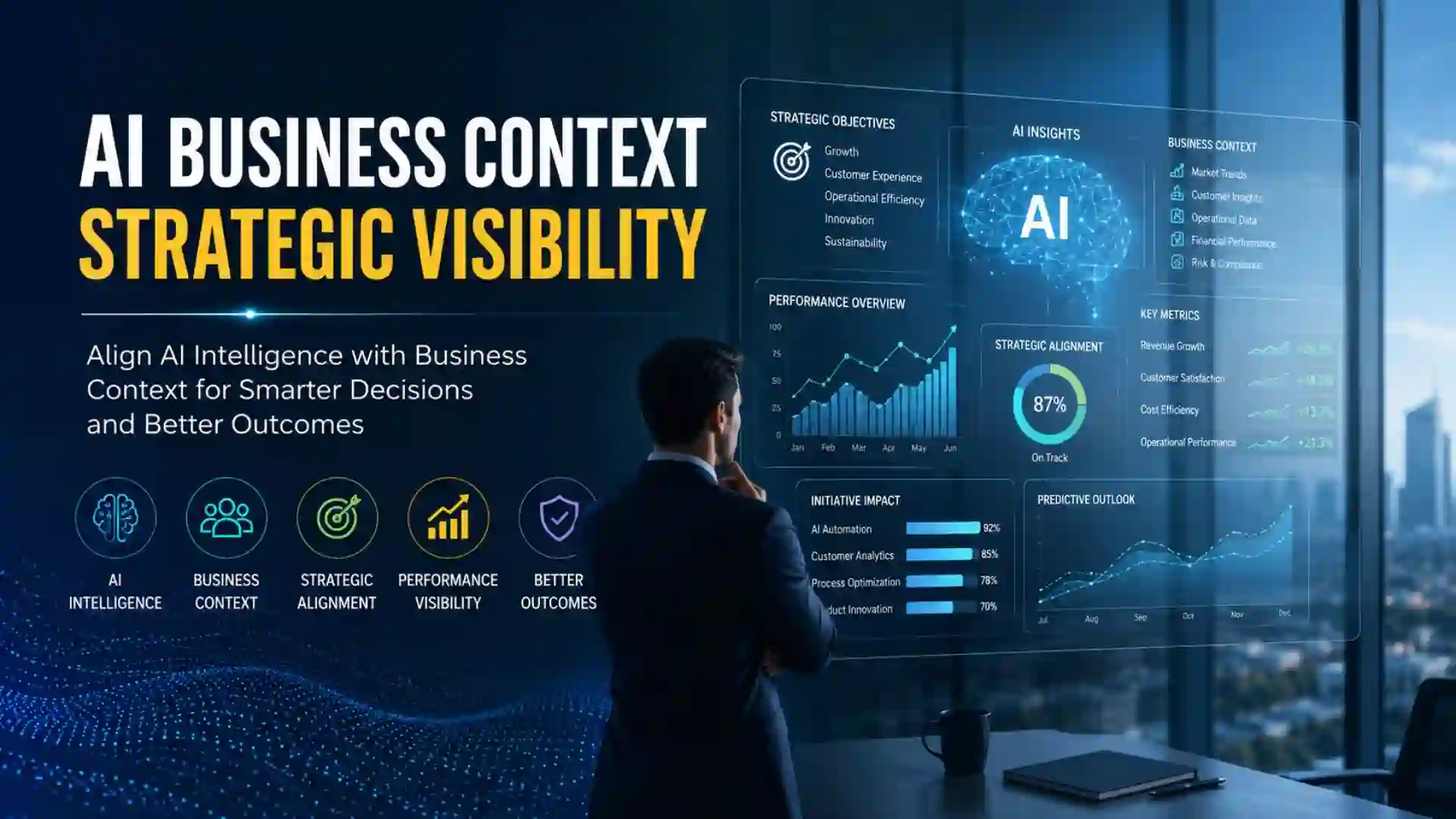
AI Business Context Strategic Visibility: Artificial intelligence has rapidly evolved from a specialized technology used by a handful of innovators into a core business capability that influences decision-making, operations, customer experiences, and long-term growth. As organizations adopt AI at scale, a new concept has emerged as a critical success factor: AI business context strategic visibility.
Many organizations invest heavily in AI tools, machine learning platforms, automation software, and data infrastructure. However, despite significant spending, a large percentage of AI initiatives fail to achieve their intended business outcomes. One of the primary reasons is the lack of business context and strategic visibility.
AI systems can process vast amounts of data and generate insights, but without a deep understanding of organizational objectives, market conditions, customer expectations, and strategic priorities, those insights often fail to create meaningful value. Strategic visibility ensures that AI initiatives align with business goals while business context helps AI systems generate recommendations that are relevant, accurate, and actionable.
You May Also Like:
- Copilot AI Review: The Complete Guide to Microsoft’s AI Assistant
- Kling AI: The Complete Guide to the Revolutionary AI Video Generator
This article explores the meaning of AI business context strategic visibility, its importance, key components, implementation strategies, benefits, challenges, and future trends.
Important Information and Resource
| Topic | Description |
|---|---|
| AI Business Context | Business-specific information that helps AI understand organizational goals, processes, and priorities |
| Strategic Visibility | The ability to view and understand strategic objectives across departments and operations |
| Primary Goal | Align AI initiatives with business outcomes |
| Key Benefit | Better decision-making and operational efficiency |
| Main Challenge | Data silos and disconnected organizational knowledge |
| Required Elements | Data integration, governance, transparency, and leadership support |
| Impact Areas | Marketing, sales, operations, finance, HR, and customer service |
| Success Metric | Business value generated from AI-driven initiatives |
| Future Trend | Context-aware AI systems with enterprise-wide visibility |
| Recommended Approach | Combine AI capabilities with strategic planning frameworks |
Understanding AI Business Context
Business context refers to the information that explains why a business operates in a certain way and what it aims to achieve.
For humans, context comes naturally. Employees understand company goals, customer expectations, industry trends, competitive pressures, and organizational culture. AI systems, however, require explicit access to this information.
Business context may include:
- Corporate objectives
- Strategic priorities
- Customer preferences
- Market conditions
- Regulatory requirements
- Industry standards
- Internal processes
- Historical performance data
- Risk management frameworks
- Organizational structures
Without context, AI may generate technically correct but strategically irrelevant recommendations.
For example, an AI model might recommend reducing customer support staffing to lower operational costs. While the recommendation may improve short-term efficiency metrics, it could conflict with a strategic objective focused on premium customer experience and long-term retention.
Business context enables AI to make recommendations that support broader organizational goals rather than isolated performance metrics.
What Is Strategic Visibility?
Strategic visibility refers to an organization’s ability to understand and monitor the alignment between daily operations and long-term strategic objectives.
In a traditional organization, strategic information is often distributed across multiple departments. Marketing focuses on customer acquisition, finance concentrates on profitability, operations prioritize efficiency, and leadership emphasizes growth.
When these departments operate independently, visibility becomes fragmented.
Strategic visibility helps organizations:
- Track progress toward objectives
- Identify performance gaps
- Align departmental initiatives
- Improve collaboration
- Support informed decision-making
- Increase organizational agility
When integrated with AI systems, strategic visibility allows technology platforms to understand how specific actions contribute to overall business success.
The Relationship Between AI, Business Context, and Strategic Visibility
AI business context strategic visibility combines three critical elements:
AI Intelligence
AI provides:
- Data analysis
- Pattern recognition
- Forecasting
- Automation
- Decision support
Business Context
Business context provides:
- Organizational knowledge
- Strategic priorities
- Operational constraints
- Customer insights
Strategic Visibility
Strategic visibility provides:
- Goal alignment
- Performance monitoring
- Cross-functional understanding
- Enterprise-wide transparency
Together, these elements create a system where AI not only analyzes information but does so in a way that supports business objectives.
This combination transforms AI from a technical tool into a strategic business asset.
Why AI Business Context Strategic Visibility Matters?
Organizations today operate in highly competitive and rapidly changing environments. Decisions must be made quickly while balancing multiple priorities.
AI business context strategic visibility helps organizations:
Improve Decision Quality
AI systems can process enormous amounts of data.
When combined with strategic context, organizations gain:
- More accurate forecasts
- Better recommendations
- Reduced decision bias
- Improved risk assessment
Decision-makers can act with greater confidence because recommendations are tied to strategic objectives.
Increase Organizational Alignment
Many companies struggle with departmental misalignment.
Marketing may focus on growth while finance prioritizes cost reduction. Operations may emphasize efficiency while customer service focuses on satisfaction.
Strategic visibility helps ensure that AI recommendations support common organizational goals.
Enhance Resource Allocation
Organizations have limited budgets, personnel, and time.
AI systems with strategic awareness can identify:
- High-value projects
- Underperforming initiatives
- Investment opportunities
- Operational inefficiencies
This improves resource utilization across the organization.
Accelerate Innovation
Innovation requires visibility into market trends, customer needs, and business capabilities.
Context-aware AI helps organizations:
- Discover emerging opportunities
- Identify unmet customer demands
- Evaluate new business models
- Reduce innovation risks
Core Components of AI Business Context Strategic Visibility
Data Integration
The foundation of strategic visibility is integrated data.
Organizations often store information in separate systems:
- CRM platforms
- ERP systems
- Marketing software
- Financial databases
- HR platforms
AI requires access to connected data sources to generate meaningful insights.
Integrated data creates a complete organizational picture.
Knowledge Management
Business knowledge often resides in documents, reports, presentations, and employee expertise.
Knowledge management systems help AI access:
- Policies
- Procedures
- Strategic plans
- Operational guidelines
- Best practices
This improves contextual understanding.
Goal Mapping
Organizations must define clear relationships between:
- Strategic goals
- Departmental objectives
- Operational activities
- Performance metrics
Goal mapping helps AI understand how actions influence broader outcomes.
Real-Time Analytics
Strategic visibility depends on current information.
Real-time analytics enables organizations to:
- Monitor performance continuously
- Detect changes quickly
- Respond to market shifts
- Track strategic progress
AI becomes significantly more effective when working with current data.
Governance Frameworks
Governance ensures responsible AI deployment.
Effective governance includes:
- Data quality standards
- Privacy controls
- Compliance requirements
- Ethical guidelines
- Accountability structures
Governance improves trust in AI-driven decisions.
Applications Across Business Functions
Marketing
Marketing teams use AI to:
- Analyze customer behavior
- Personalize campaigns
- Forecast demand
- Optimize advertising spend
Business context helps AI understand:
- Brand positioning
- Target audiences
- Competitive dynamics
- Growth objectives
Strategic visibility ensures marketing activities align with overall business goals.
Sales
Sales organizations benefit from:
- Lead scoring
- Revenue forecasting
- Pipeline analysis
- Customer segmentation
Context-aware AI identifies opportunities that support strategic priorities rather than simply maximizing short-term revenue.
Customer Service
AI-powered customer service solutions improve:
- Response times
- Customer satisfaction
- Issue resolution
- Service efficiency
Strategic visibility helps balance cost optimization with customer experience objectives.
Human Resources
HR teams use AI for:
- Recruitment
- Workforce planning
- Employee engagement
- Performance management
Business context ensures talent strategies align with organizational growth plans.
Finance
Finance departments leverage AI for:
- Forecasting
- Budget planning
- Risk management
- Fraud detection
Strategic visibility improves financial decision-making and investment prioritization.
Operations
Operational teams use AI to:
- Optimize supply chains
- Improve productivity
- Reduce waste
- Enhance quality control
Business context ensures operational improvements support strategic objectives.
Building AI Business Context Strategic Visibility
Establish Clear Strategic Objectives
Organizations should begin by defining:
- Vision
- Mission
- Long-term goals
- Key performance indicators
AI systems require clearly articulated objectives to support effective decision-making.
Create a Unified Data Environment
A unified data environment eliminates information silos.
Key actions include:
- Data standardization
- System integration
- Centralized analytics
- Shared reporting frameworks
Unified data improves organizational visibility.
Develop Context-Rich AI Models
Traditional AI models focus primarily on data patterns.
Context-rich models incorporate:
- Business rules
- Strategic objectives
- Industry knowledge
- Organizational priorities
This improves recommendation quality.
Foster Cross-Functional Collaboration
Strategic visibility requires collaboration between:
- Leadership teams
- Business units
- IT departments
- Data scientists
Cross-functional engagement ensures AI reflects organizational realities.
Monitor and Refine Continuously
Business environments change constantly.
Organizations should:
- Review AI performance regularly
- Update strategic priorities
- Improve data quality
- Refine contextual models
Continuous improvement maintains relevance and effectiveness.
Common Challenges
Data Silos
Many organizations struggle with fragmented information systems.
Data silos limit AI effectiveness by preventing access to complete business context.
Inconsistent Data Quality
Poor-quality data creates unreliable outputs.
Organizations must establish strong data management practices.
Lack of Strategic Clarity
AI systems cannot align with objectives that are poorly defined.
Clear strategies are essential.
Resistance to Change
Employees may hesitate to trust AI-generated recommendations.
Leadership must promote transparency and education.
Governance Complexity
As AI becomes more powerful, governance requirements become more demanding.
Organizations must balance innovation with accountability.
Measuring Success
Organizations should evaluate AI business context strategic visibility using multiple metrics.
Strategic Alignment Metrics
Examples include:
- Goal achievement rates
- Initiative success rates
- Strategic project completion
Operational Metrics
Examples include:
- Productivity improvements
- Process efficiency gains
- Cost reductions
Financial Metrics
Examples include:
- Revenue growth
- Profitability improvements
- Return on AI investment
Customer Metrics
Examples include:
- Customer satisfaction
- Retention rates
- Net promoter scores
Employee Metrics
Examples include:
- Engagement levels
- Workforce productivity
- Talent retention
A balanced scorecard approach often provides the most comprehensive assessment.
Emerging Trends
Generative AI for Strategic Planning
Generative AI is increasingly assisting organizations with:
- Scenario analysis
- Strategic forecasting
- Market assessments
- Competitive intelligence
These capabilities improve executive decision-making.
Enterprise Knowledge Graphs
Knowledge graphs connect organizational information into structured relationships.
This significantly enhances business context for AI systems.
Real-Time Strategy Monitoring
Organizations are moving toward continuous strategy execution tracking rather than periodic reviews.
AI plays a central role in this transition.
Autonomous Decision Support
Future AI systems will increasingly provide autonomous recommendations supported by rich contextual understanding.
Human oversight will remain important, but decision-making processes will become more intelligent and efficient.
Context-Aware Enterprise Agents
Advanced AI agents will understand:
- Company goals
- Department priorities
- Operational constraints
- Customer expectations
These agents will act as strategic assistants throughout the organization.
Best Practices for Organizations
To maximize the value of AI business context strategic visibility, organizations should:
- Start with clear business objectives.
- Invest in data integration.
- Break down organizational silos.
- Build strong governance frameworks.
- Prioritize transparency and explainability.
- Encourage cross-functional collaboration.
- Continuously update business context information.
- Measure outcomes using business-focused metrics.
- Train employees on AI capabilities and limitations.
- Treat AI as a strategic capability rather than a standalone technology project.
FAQ about AI Business Context Strategic Visibility
What is AI business context strategic visibility?
AI business context strategic visibility refers to the integration of artificial intelligence, organizational knowledge, and strategic oversight to ensure AI-generated insights align with business objectives and long-term goals.
Why is business context important for AI?
Business context helps AI understand organizational priorities, customer needs, operational constraints, and strategic objectives. Without context, AI recommendations may be technically accurate but strategically irrelevant.
What does strategic visibility mean?
Strategic visibility is the ability to monitor and understand how business activities contribute to organizational goals. It provides transparency across departments and supports informed decision-making.
How does strategic visibility improve AI performance?
Strategic visibility gives AI access to organizational goals and performance indicators, enabling recommendations that align with business priorities rather than isolated metrics.
Which departments benefit most from AI business context strategic visibility?
Marketing, sales, finance, operations, customer service, and human resources all benefit from improved alignment between AI insights and strategic objectives.
What are the biggest implementation challenges?
Common challenges include data silos, poor data quality, unclear strategic objectives, resistance to change, and governance complexities.
Can small businesses use this approach?
Yes. Small businesses can benefit by connecting data sources, defining clear objectives, and using AI tools that incorporate business context into decision-making processes.
What technologies support strategic visibility?
Technologies include business intelligence platforms, data warehouses, knowledge management systems, AI analytics tools, enterprise resource planning systems, and customer relationship management platforms.
Conclusion
AI business context strategic visibility represents the next stage in enterprise AI maturity. Organizations are increasingly recognizing that AI alone does not create business value. Success comes from combining advanced analytics with deep organizational understanding and strategic alignment.
Business context provides the knowledge AI needs to generate meaningful recommendations, while strategic visibility ensures those recommendations support long-term organizational goals. Together, they create a framework that transforms AI from a data-processing tool into a strategic decision-making partner.
As enterprises continue investing in digital transformation, the organizations that successfully integrate AI, business context, and strategic visibility will be better positioned to improve decision-making, increase operational efficiency, enhance customer experiences, and maintain competitive advantage. The future of enterprise AI will not simply be about intelligence; it will be about intelligent systems that understand business priorities and contribute directly to strategic success.