
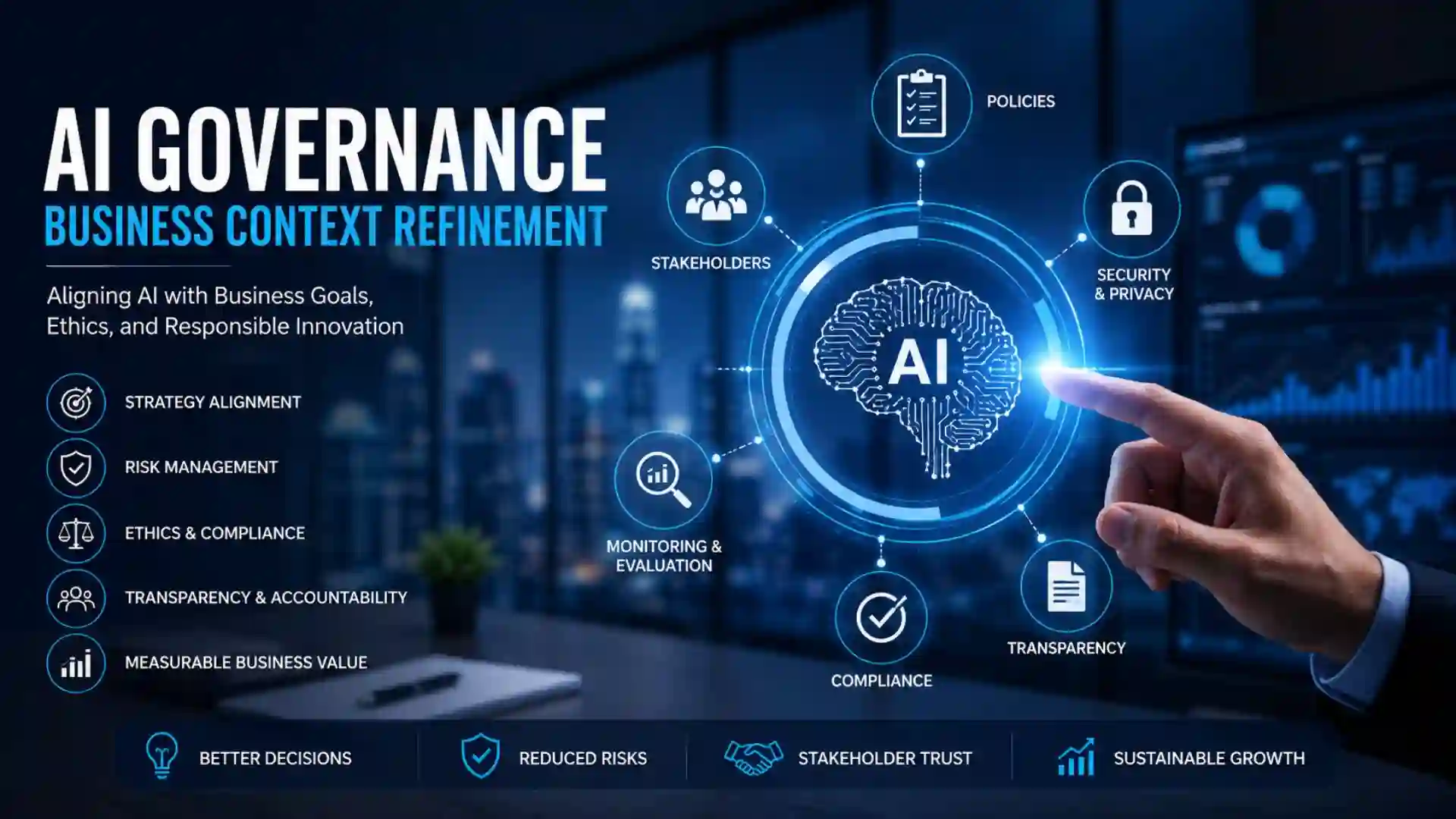
AI Governance Business Context Refinement: Artificial Intelligence (AI) is rapidly transforming the way businesses operate. From automating repetitive tasks and improving customer experiences to enhancing decision-making and driving innovation, AI has become a strategic asset for organizations across industries. However, the successful implementation of AI requires more than advanced algorithms and powerful computing infrastructure. Organizations must ensure that AI systems align with business objectives, regulatory requirements, ethical standards, and stakeholder expectations. This is where AI governance and business context refinement play a critical role.
AI governance provides the framework for managing AI systems responsibly, while business context refinement ensures that AI solutions are developed and deployed with a deep understanding of organizational goals, industry-specific requirements, and operational realities. Together, these concepts help organizations maximize the value of AI while minimizing risks.
This article explores AI governance business context refinement, its importance, key components, benefits, challenges, implementation strategies, and future trends.
Understanding AI Governance
AI governance refers to the policies, processes, standards, and controls that guide the development, deployment, and management of AI systems within an organization. It ensures that AI technologies operate in a manner that is ethical, transparent, secure, compliant, and aligned with business objectives.
AI governance encompasses several critical areas:
- Ethical AI practices
- Data privacy and security
- Regulatory compliance
- Risk management
- Transparency and explainability
- Accountability and oversight
- Performance monitoring
- Human-in-the-loop decision-making
Without proper governance, organizations may face legal liabilities, reputational damage, biased outcomes, security breaches, and operational inefficiencies.
What Is Business Context Refinement?
Business context refinement is the process of continuously improving and clarifying the business environment, objectives, constraints, and operational requirements that influence AI system design and implementation.
Rather than building AI models solely based on technical considerations, business context refinement ensures that AI solutions address real organizational challenges and deliver measurable value.
This process involves:
- Understanding business goals
- Identifying stakeholder needs
- Analyzing industry regulations
- Evaluating operational workflows
- Defining performance expectations
- Assessing risk tolerance
- Incorporating market conditions
- Aligning AI outcomes with strategic priorities
Business context refinement acts as a bridge between technical AI development teams and business decision-makers.
Important Information
| Topic | Description |
|---|---|
| AI Governance | Framework for managing AI responsibly and effectively |
| Business Context Refinement | Aligning AI systems with organizational objectives and operational realities |
| Key Goal | Ensure AI creates measurable business value while minimizing risk |
| Primary Stakeholders | Executives, compliance teams, data scientists, legal departments, business units |
| Governance Focus Areas | Ethics, transparency, compliance, security, accountability |
| Context Refinement Focus Areas | Business objectives, workflows, industry requirements, customer needs |
| Benefits | Better decision-making, risk reduction, regulatory compliance, improved ROI |
| Common Challenges | Data quality issues, changing regulations, organizational resistance |
| Success Factors | Leadership support, continuous monitoring, cross-functional collaboration |
| Future Direction | Adaptive governance, explainable AI, automated compliance systems |
Why AI Governance Needs Business Context Refinement?
Many AI projects fail because organizations focus heavily on technology while neglecting business realities. Even technically accurate models may produce limited value if they are not aligned with actual business needs.
For example, an AI-powered customer support system may achieve high prediction accuracy but fail to improve customer satisfaction if it ignores customer preferences, operational constraints, or service policies.
Business context refinement ensures that governance frameworks remain practical and relevant by considering:
Organizational Strategy
AI systems should support long-term business goals rather than operate as isolated technology initiatives.
Industry-Specific Requirements
Healthcare, finance, insurance, manufacturing, and retail industries have unique regulations and operational needs that must be reflected in AI governance frameworks.
Stakeholder Expectations
Different stakeholders often have different priorities. Business context refinement helps balance competing interests while maintaining governance standards.
Dynamic Market Conditions
Business environments constantly evolve. Governance structures must adapt to changing customer behaviors, competitive pressures, and regulatory developments.
Key Components of AI Governance Business Context Refinement
Strategic Alignment
The first component involves ensuring that AI initiatives directly contribute to business objectives.
Organizations should ask:
- What problem is the AI system solving?
- How does it support strategic goals?
- What business outcomes are expected?
Strategic alignment prevents wasted investments and improves AI project success rates.
Stakeholder Mapping
AI impacts multiple groups within an organization.
Stakeholder mapping identifies:
- Executive leadership
- Employees
- Customers
- Partners
- Regulators
- Investors
Understanding stakeholder expectations helps organizations create balanced governance frameworks.
Data Governance Integration
Data is the foundation of AI systems.
Business context refinement requires evaluating:
- Data ownership
- Data quality
- Data privacy
- Data security
- Data accessibility
Strong data governance enhances AI reliability and regulatory compliance.
Risk Assessment
Different business environments involve different levels of risk.
Organizations should evaluate:
- Financial risks
- Legal risks
- Operational risks
- Reputational risks
- Cybersecurity risks
Risk assessments help determine appropriate governance controls.
Performance Metrics
Success must be measured using both technical and business indicators.
Examples include:
- Revenue growth
- Customer satisfaction
- Operational efficiency
- Accuracy rates
- Cost reduction
- Compliance performance
Balanced metrics ensure that AI delivers real business value.
The Role of Leadership in Context Refinement
Executive leadership plays a crucial role in AI governance success.
Leaders are responsible for:
- Defining AI strategy
- Establishing governance policies
- Allocating resources
- Managing organizational change
- Promoting responsible AI practices
Without leadership support, governance initiatives often struggle to gain traction.
Successful organizations treat AI governance as a strategic business function rather than a purely technical responsibility.
Ethical Considerations
Ethics is a fundamental component of AI governance.
Business context refinement helps organizations identify ethical concerns specific to their operations.
Common ethical considerations include:
Bias and Fairness
AI systems can unintentionally produce discriminatory outcomes if training data contains biases.
Organizations must regularly evaluate:
- Data sources
- Model outputs
- Decision impacts
Transparency
Stakeholders should understand how AI systems make decisions.
Transparency improves:
- Trust
- Accountability
- Regulatory compliance
Human Oversight
Critical decisions should involve human review when necessary.
Human oversight reduces the likelihood of harmful or inappropriate outcomes.
Responsible Data Usage
Organizations must use customer and employee data responsibly while respecting privacy rights and legal obligations.
Regulatory Compliance and Business Context
AI regulations are evolving worldwide.
Business context refinement helps organizations adapt governance frameworks to regulatory requirements.
Important compliance areas include:
- Data protection laws
- Consumer protection regulations
- Industry-specific standards
- AI accountability requirements
- Security mandates
Organizations operating across multiple regions must consider jurisdiction-specific regulations during governance planning.
Benefits of AI Governance Business Context Refinement
Improved Decision-Making
Refined business context enables AI systems to provide insights that are more relevant and actionable.
Higher Return on Investment
Organizations achieve greater value from AI investments when projects align closely with business goals.
Reduced Risk Exposure
Governance controls combined with contextual understanding help prevent compliance violations and operational failures.
Increased Stakeholder Trust
Transparent and responsible AI practices improve confidence among customers, employees, and regulators.
Better Resource Allocation
Organizations can prioritize AI initiatives that offer the greatest strategic impact.
Enhanced Adaptability
Business context refinement allows governance frameworks to evolve alongside changing business conditions.
Challenges in Implementing Business Context Refinement
Complex Organizational Structures
Large organizations often have multiple departments with conflicting priorities.
Aligning governance frameworks across business units can be difficult.
Rapid Technological Change
AI technologies evolve quickly.
Governance policies must remain flexible enough to accommodate innovation.
Data Silos
Fragmented data environments can hinder effective context refinement.
Organizations must improve data sharing and collaboration.
Regulatory Uncertainty
AI regulations continue to develop globally.
Businesses must monitor changes and update governance frameworks accordingly.
Skills Gaps
Many organizations lack professionals with expertise in both AI technology and business strategy.
Cross-functional training and collaboration can help address this challenge.
Building an Effective AI Governance Framework
Establish Governance Committees
Organizations should create dedicated governance teams responsible for oversight and decision-making.
These teams typically include:
- Business leaders
- Data scientists
- Legal experts
- Risk managers
- Compliance officers
Define Governance Policies
Policies should clearly address:
- AI development standards
- Data management requirements
- Ethical guidelines
- Monitoring procedures
Conduct Context Reviews
Regular reviews ensure that AI systems remain aligned with evolving business needs.
Review areas include:
- Strategic objectives
- Customer expectations
- Market conditions
- Regulatory requirements
Implement Monitoring Systems
Continuous monitoring helps detect:
- Model drift
- Performance issues
- Compliance violations
- Emerging risks
Create Feedback Loops
Organizations should gather feedback from:
- End users
- Employees
- Customers
- Regulators
Feedback supports ongoing refinement and improvement.
AI Governance Across Different Industries
Healthcare
Healthcare organizations must balance innovation with patient safety and privacy requirements.
Context refinement focuses on:
- Clinical outcomes
- Regulatory compliance
- Patient trust
Financial Services
Financial institutions use governance frameworks to manage:
- Credit decisions
- Fraud detection
- Regulatory reporting
Context refinement helps ensure fairness and transparency.
Retail
Retail organizations refine business context by considering:
- Customer behavior
- Market trends
- Inventory management
Governance ensures responsible use of customer data.
Manufacturing
Manufacturers use AI for:
- Predictive maintenance
- Quality control
- Supply chain optimization
Context refinement aligns AI systems with operational efficiency goals.
Best Practices for Successful Implementation
Start With Business Objectives
Every AI initiative should begin with clearly defined business goals.
Involve Multiple Stakeholders
Cross-functional collaboration improves governance quality and contextual understanding.
Prioritize Transparency
Transparent AI systems build trust and support accountability.
Monitor Continuously
Governance is an ongoing process rather than a one-time project.
Update Policies Regularly
Policies should evolve alongside technological, regulatory, and business changes.
Invest in Education
Training programs help employees understand governance responsibilities and AI risks.
Future Trends in AI Governance Business Context Refinement
Several trends are shaping the future of AI governance:
Automated Governance Tools
Organizations are increasingly using AI-powered governance platforms to monitor compliance and risk.
Explainable AI
Demand for explainable AI solutions will continue to grow as regulators and stakeholders seek greater transparency.
Adaptive Governance Models
Future governance frameworks will dynamically adjust based on changing business conditions and risk levels.
Integrated Risk Management
Organizations will increasingly combine AI governance with broader enterprise risk management programs.
Industry-Specific Governance Standards
More industries are expected to develop specialized governance frameworks tailored to unique operational requirements.
Real-Time Context Analysis
Advanced analytics will enable organizations to continuously refine business context and governance controls.
FAQ about AI Governance Business Context Refinement
What is AI governance?
AI governance is a structured framework of policies, procedures, and controls that ensures AI systems are developed and used responsibly, ethically, securely, and in compliance with regulations.
What does business context refinement mean in AI?
Business context refinement involves continuously aligning AI systems with organizational goals, operational requirements, stakeholder expectations, and industry regulations.
Why is business context important for AI governance?
Business context ensures that AI systems address real organizational needs, deliver measurable value, and operate within acceptable risk boundaries.
Who is responsible for AI governance?
AI governance is a shared responsibility involving executives, business leaders, compliance teams, legal departments, data scientists, and risk management professionals.
How does AI governance reduce risk?
Governance frameworks help identify, assess, monitor, and mitigate risks related to bias, privacy, security, compliance, and operational performance.
What industries benefit most from AI governance?
All industries benefit from AI governance, particularly healthcare, finance, retail, manufacturing, insurance, and government sectors.
How often should business context be refined?
Organizations should review and refine business context regularly, especially when strategic goals, regulations, market conditions, or operational processes change.
Can small businesses implement AI governance?
Yes. Small businesses can adopt simplified governance frameworks focused on transparency, compliance, ethical practices, and risk management.
Conclusion
AI governance business context refinement represents a critical foundation for successful and responsible AI adoption. While governance provides the structure and controls necessary to manage AI systems effectively, business context refinement ensures that those systems remain aligned with organizational goals, stakeholder expectations, and evolving market realities.
Organizations that integrate governance and contextual understanding into their AI strategies are better positioned to maximize innovation, improve operational efficiency, reduce risk, and maintain regulatory compliance. As AI technologies continue to evolve, businesses must move beyond purely technical implementations and embrace governance models that incorporate strategic, ethical, and operational considerations.
The future of AI success will not depend solely on algorithmic sophistication. It will depend on an organization’s ability to govern AI responsibly while continuously refining the business context in which AI operates. Companies that master this balance will be better equipped to create sustainable value, build stakeholder trust, and achieve long-term competitive advantage in an increasingly AI-driven world.