
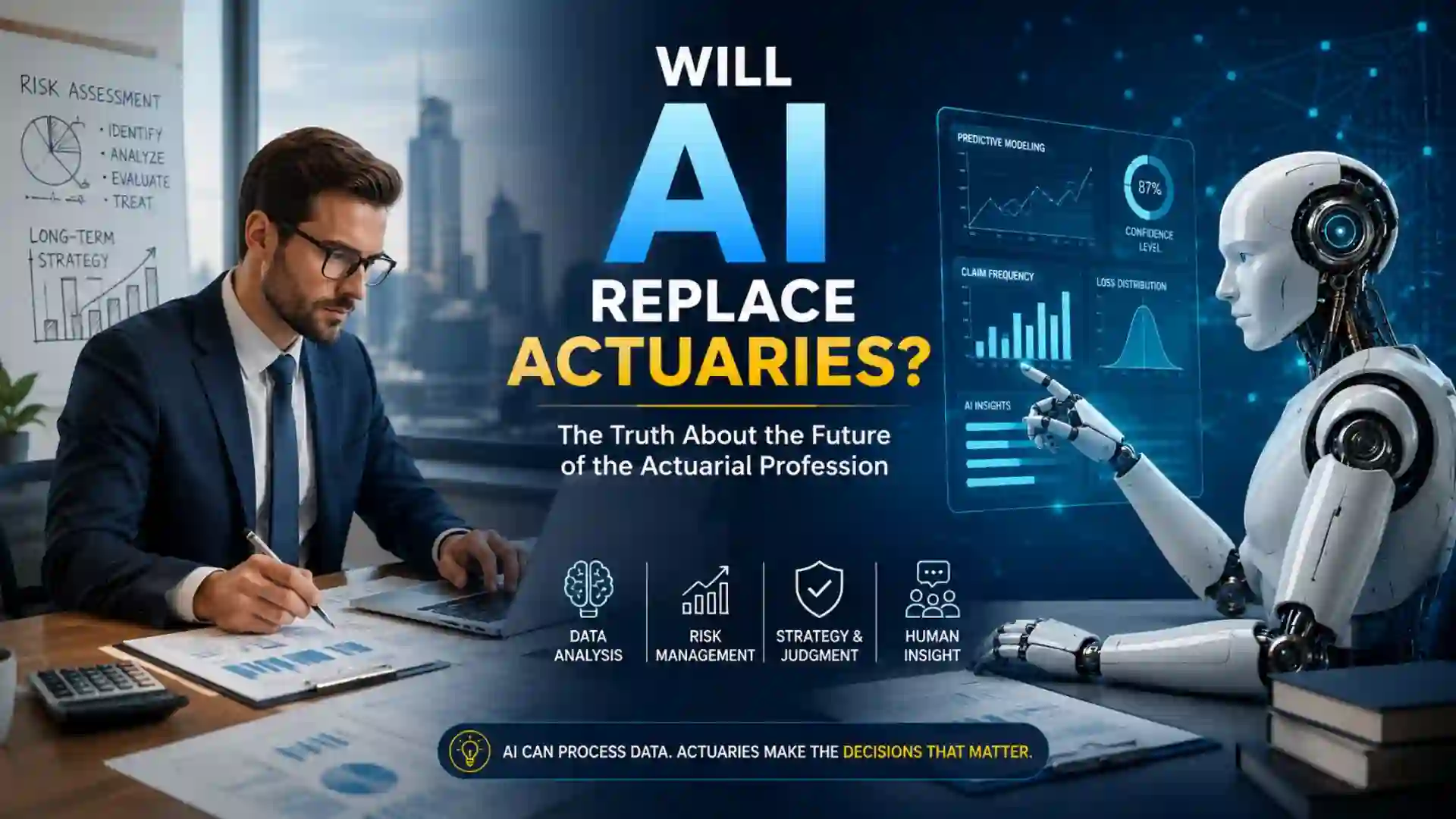
Will AI Replace Actuaries? Artificial intelligence has transformed many industries over the past decade, leading professionals in numerous fields to wonder whether their jobs are at risk. Among the professions frequently discussed in this context is actuarial science. Actuaries have long been recognized as highly skilled experts who analyze risk, predict future financial outcomes, and help organizations make informed decisions. With AI systems becoming increasingly capable of handling complex calculations, data analysis, and predictive modeling, a common question arises: will AI replace actuaries?
The short answer is no, but the complete answer is more nuanced. AI is likely to change the actuarial profession significantly, automating many repetitive tasks and enhancing analytical capabilities. However, the core responsibilities of actuaries extend far beyond calculations and statistical modeling. Human judgment, business understanding, regulatory knowledge, communication skills, and ethical decision-making remain essential components of actuarial work.
This article explores how AI is impacting actuarial science, what aspects of the profession may become automated, which skills will remain valuable, and what the future holds for actuaries in an AI-driven world.
Understanding the Role of Actuaries
Before evaluating whether AI can replace actuaries, it is important to understand what actuaries actually do.
Actuaries are professionals who use mathematics, statistics, economics, and financial theory to assess risk and uncertainty. They work primarily in industries such as insurance, pensions, healthcare, investments, and risk management.
Their responsibilities often include:
- Evaluating financial risks
- Designing insurance products
- Calculating premiums
- Forecasting future claims
- Assessing pension liabilities
- Developing risk management strategies
- Ensuring regulatory compliance
- Communicating complex findings to stakeholders
While mathematical modeling forms a significant part of actuarial work, much of the profession involves interpreting results and helping organizations make strategic decisions.
Why People Think AI Could Replace Actuaries?
Several developments have contributed to concerns about AI replacing actuaries.
Advanced Data Analysis
Modern AI systems can process massive datasets much faster than humans. Machine learning algorithms can identify patterns, trends, and correlations that may be difficult for traditional actuarial methods to detect.
Predictive Modeling
Many actuarial tasks involve predicting future outcomes. AI excels at prediction, especially when large amounts of historical data are available.
Automation of Routine Work
Tasks such as data cleaning, report generation, and model testing can increasingly be automated through AI-powered tools.
Growing Adoption in Insurance
Insurance companies are rapidly adopting AI technologies for underwriting, claims processing, fraud detection, customer service, and risk assessment.
Because actuaries are heavily involved in these functions, some observers assume AI will eventually eliminate the need for human actuaries.
How AI Is Already Transforming Actuarial Work?
Rather than replacing actuaries outright, AI is currently serving as a powerful tool that enhances productivity and efficiency.
Improved Risk Assessment
Machine learning algorithms can analyze customer behavior, market conditions, demographic information, and historical claims data to produce more accurate risk assessments.
Actuaries can leverage these insights to create more refined pricing models and better understand emerging risks.
Faster Data Processing
Traditionally, actuaries spend significant time gathering, validating, and preparing data. AI systems can automate many of these processes, allowing actuaries to focus on higher-value activities.
Enhanced Fraud Detection
Insurance fraud costs companies billions of dollars annually. AI can identify suspicious patterns in claims data that may indicate fraudulent activity.
Actuaries can use these insights to improve risk management strategies and financial forecasting.
Real-Time Analytics
Traditional actuarial models are often updated periodically. AI systems can continuously monitor data and provide real-time insights, enabling faster decision-making.
Better Customer Segmentation
AI can identify customer groups with greater precision, helping insurers develop more personalized products and pricing strategies.
Tasks AI May Eventually Automate
Although AI is unlikely to replace actuaries entirely, some actuarial functions may become heavily automated.
Data Collection and Cleaning
One of the most time-consuming aspects of actuarial work involves preparing data for analysis. AI-powered systems can automate much of this process.
Basic Statistical Analysis
Routine statistical calculations and standard modeling techniques can increasingly be performed by automated systems.
Report Generation
AI can create summaries, dashboards, and preliminary reports with minimal human involvement.
Standard Pricing Models
For relatively straightforward insurance products, AI may handle much of the pricing analysis currently performed by actuaries.
Model Validation
AI tools can assist with testing and validating models more efficiently than traditional methods.
These changes may reduce the amount of manual work actuaries perform, but they do not eliminate the need for actuarial expertise.
Why AI Cannot Fully Replace Actuaries?
Despite its impressive capabilities, AI faces significant limitations that prevent it from fully replacing actuaries.
Human Judgment Remains Essential
Actuarial decisions often involve uncertainty, incomplete information, and competing priorities.
For example, an insurer may need to balance profitability, customer satisfaction, regulatory requirements, and competitive pressures when setting premiums.
AI can provide recommendations, but humans must ultimately decide which course of action best aligns with organizational goals.
Regulatory Compliance Requires Human Oversight
Insurance and financial industries operate within highly regulated environments.
Actuaries must ensure that models, assumptions, and business practices comply with complex legal and regulatory standards.
Regulators often require transparency and accountability that AI systems alone cannot provide.
Communication Skills Matter
Actuaries frequently communicate technical findings to executives, regulators, clients, and other stakeholders.
Explaining risk assessments, strategic recommendations, and financial implications requires strong interpersonal and communication skills that AI cannot replicate effectively.
Ethical Considerations
AI models can inadvertently introduce bias or discrimination into decision-making processes.
Actuaries play an important role in evaluating whether models are fair, ethical, and socially responsible.
Human oversight remains critical for maintaining trust and accountability.
Strategic Decision-Making
Organizations rely on actuaries not only for calculations but also for strategic guidance.
Actuaries help leadership teams understand risks, evaluate opportunities, and make informed business decisions.
These responsibilities require contextual understanding and business judgment beyond the capabilities of current AI systems.
The Future Actuary: Working Alongside AI
The most likely future scenario is not AI replacing actuaries but actuaries working alongside AI.
In many ways, AI may become the actuarial profession’s most valuable tool.
Future actuaries will likely spend less time on manual calculations and more time on:
- Strategic analysis
- Risk interpretation
- Model governance
- Ethical oversight
- Business consulting
- Regulatory compliance
- Decision support
As AI handles repetitive tasks, actuaries can focus on activities that require uniquely human skills.
Skills Future Actuaries Will Need
To remain competitive in an AI-driven environment, actuaries should develop a broader skill set.
Data Science Knowledge
Understanding machine learning, artificial intelligence, and advanced analytics will become increasingly important.
Actuaries who can work effectively with AI systems will have a significant advantage.
Programming Skills
Knowledge of programming languages such as Python, R, SQL, and related technologies can enhance career opportunities.
Business Acumen
Future actuaries will need a deeper understanding of business strategy, economics, and organizational decision-making.
Communication Abilities
The ability to explain technical concepts to non-technical audiences will remain highly valuable.
Ethical and Regulatory Expertise
As AI adoption increases, organizations will need professionals who understand both technological capabilities and regulatory responsibilities.
Industries Where Actuaries Will Continue to Thrive
Several sectors are likely to maintain strong demand for actuarial expertise.
Insurance
Insurance remains the largest employer of actuaries and will continue to require professionals who understand risk and regulatory requirements.
Healthcare
Healthcare systems face growing complexity and uncertainty, creating opportunities for actuaries to contribute valuable insights.
Retirement and Pensions
Managing pension funds and retirement programs requires long-term forecasting and strategic planning that benefits from actuarial expertise.
Enterprise Risk Management
Organizations increasingly recognize the importance of comprehensive risk management across all aspects of business operations.
Climate Risk Analysis
Climate change introduces new forms of uncertainty that require sophisticated risk assessment and scenario modeling.
Actuaries are well-positioned to help organizations understand and manage these emerging challenges.
Important Information About AI and Actuaries
| Topic | Key Information |
|---|---|
| Will AI replace actuaries completely? | Highly unlikely in the foreseeable future |
| Main impact of AI | Automation of repetitive and data-intensive tasks |
| Tasks most vulnerable to automation | Data preparation, routine modeling, report generation |
| Tasks least vulnerable to automation | Strategic decision-making, communication, judgment |
| Industries employing actuaries | Insurance, healthcare, pensions, finance, risk management |
| Benefits of AI for actuaries | Faster analysis, improved accuracy, enhanced insights |
| Human skills still required | Ethics, leadership, communication, business understanding |
| Future outlook | Collaboration between AI and actuaries |
| Career prospects | Expected to remain strong for adaptable professionals |
| Recommended skills | Data science, programming, business strategy, AI literacy |
Benefits of AI for the Actuarial Profession
Many discussions focus on the risks AI poses to jobs, but it also creates significant opportunities.
Increased Productivity
Actuaries can complete projects more quickly by leveraging automated tools.
Better Decision-Making
AI-generated insights can improve the quality of business decisions.
Enhanced Accuracy
Advanced algorithms may reduce human errors in certain calculations and analyses.
Greater Innovation
AI enables actuaries to explore new modeling techniques and business solutions.
Expanded Career Opportunities
Professionals who combine actuarial expertise with AI knowledge may become highly sought-after specialists.
Challenges Actuaries May Face
Although the profession remains valuable, adaptation will be necessary.
Continuous Learning
Actuaries must stay current with evolving technologies and analytical methods.
Technology Integration
Organizations may expect actuaries to understand both traditional actuarial methods and modern AI tools.
Increased Competition
Professionals with data science and AI skills may compete for roles that were traditionally actuarial.
Changing Job Responsibilities
Some traditional tasks may become less important as automation expands.
What Employers Are Looking For?
Many employers now seek actuaries who can bridge the gap between traditional actuarial science and emerging technologies.
Desired qualifications increasingly include:
- Statistical expertise
- Machine learning knowledge
- Data visualization skills
- Programming experience
- Business strategy understanding
- Leadership capabilities
The most successful actuaries will likely be those who embrace technological change rather than resist it.
FAQ about Will AI Replace Actuaries?
Will AI eliminate actuarial jobs?
AI is unlikely to eliminate actuarial jobs entirely. Instead, it will automate routine tasks while creating opportunities for actuaries to focus on higher-level analysis, strategy, and decision-making.
Are actuaries at risk from machine learning?
Certain actuarial tasks may be affected by machine learning, but the profession itself remains valuable because organizations still need human judgment, regulatory expertise, and communication skills.
Should students still pursue actuarial science?
Yes. Actuarial science remains a strong career choice, especially for students willing to develop skills in data science, programming, and AI technologies.
Can AI perform actuarial calculations?
Yes. AI can perform many calculations and analyses efficiently. However, interpreting results, managing risk, and making strategic recommendations still require human expertise.
What skills will future actuaries need?
Future actuaries will benefit from learning programming, machine learning, business strategy, communication, and regulatory compliance in addition to traditional actuarial knowledge.
Is actuarial science becoming obsolete?
No. The profession is evolving rather than becoming obsolete. AI is changing how actuaries work, but it is not eliminating the need for actuarial expertise.
Will AI reduce the demand for actuaries?
Demand may shift toward actuaries with stronger technology and data science skills, but organizations will continue to need professionals who can interpret risks and guide strategic decisions.
Can AI replace actuarial judgment?
Current AI systems cannot fully replicate human judgment, ethical reasoning, or contextual decision-making, which remain essential aspects of actuarial work.
Conclusion
The question “Will AI replace actuaries?” reflects broader concerns about automation and the future of professional work. While AI is transforming the actuarial profession, the evidence suggests that complete replacement is highly unlikely. AI excels at processing data, identifying patterns, and automating repetitive tasks, but actuarial work involves much more than calculations.
Actuaries provide critical judgment, strategic insight, regulatory expertise, ethical oversight, and communication skills that remain difficult for AI systems to replicate. Rather than eliminating the profession, AI is reshaping it. The actuaries who thrive in the coming decades will be those who embrace technology, develop new skills, and learn to leverage AI as a powerful tool.
The future belongs not to AI alone and not to traditional actuarial methods alone, but to professionals who can successfully combine actuarial expertise with advanced technology. In that environment, actuaries are likely to remain valuable, relevant, and in demand for many years to come.