
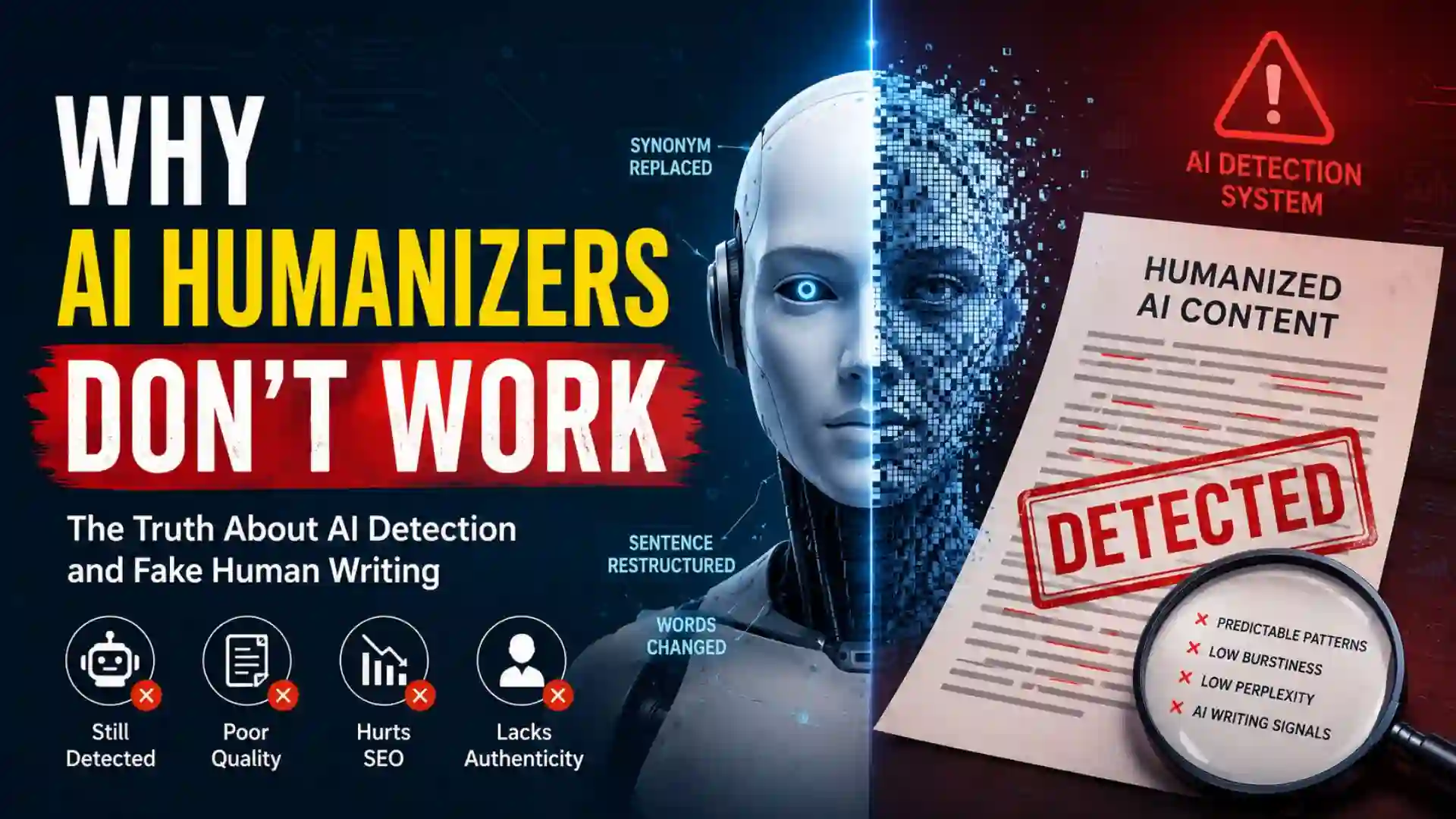
Why AI Humanizers Don’t Work? Artificial intelligence has transformed content creation at an incredible pace. From blog writing and marketing copy to academic assistance and customer support, AI-generated text is now everywhere. Alongside this growth, another category of tools has rapidly gained popularity: AI humanizers.
AI humanizers claim to convert robotic or detectable AI text into writing that appears fully human. These tools promise to bypass AI detectors, improve readability, and make machine-generated content sound natural. Many students, bloggers, freelancers, and marketers use them hoping to avoid detection systems or create more authentic content.
However, despite the marketing promises, AI humanizers often fail to achieve their intended goals. In many cases, they produce awkward writing, reduce clarity, damage SEO quality, and still remain detectable by advanced AI detection systems. The idea of perfectly disguising AI-generated text is far more complicated than most users realize.
This article explores why AI humanizers do not work effectively, how AI detectors continue to evolve, and why relying on humanizers can actually hurt content quality and credibility.
Understanding AI Humanizers
AI humanizers are software tools designed to rewrite AI-generated content so it appears more human-like. These tools typically change sentence structures, replace words with synonyms, alter paragraph flow, and introduce informal phrasing.
The primary goals of AI humanizers include:
- Reducing AI detection scores
- Making text sound conversational
- Avoiding repetitive sentence patterns
- Improving “human authenticity”
- Helping users bypass plagiarism or AI detection systems
Most humanizer tools operate using automated paraphrasing models. They do not truly understand meaning, context, emotion, or intent in the way humans do. Instead, they statistically modify text patterns.
Popular use cases include:
- Students trying to bypass AI detection
- Bloggers rewriting ChatGPT outputs
- Affiliate marketers mass-producing content
- Agencies creating bulk SEO articles
- Freelancers attempting to save writing time
Although the demand for these tools is growing, their limitations are becoming increasingly obvious.
Important Information About AI Humanizers
| Topic | Details |
|---|---|
| Main Purpose | Rewrite AI-generated text to sound human |
| Common Techniques | Synonym replacement, sentence restructuring, paraphrasing |
| Primary Users | Students, bloggers, marketers, freelancers |
| Biggest Weakness | Lack of genuine human understanding |
| Common Result | Awkward or unnatural writing |
| SEO Risk | Reduced content quality and readability |
| Detection Risk | Advanced AI detectors still recognize patterns |
| Human Creativity | Cannot be replicated through automated rewriting |
| Long-Term Reliability | Very poor due to improving detection systems |
| Better Alternative | Human editing and original writing |
AI Humanizers Depend on Predictable Patterns
One major reason AI humanizers fail is that they still rely on algorithmic rewriting systems. Even though the wording changes, the underlying patterns remain machine-generated.
Human writing contains unpredictability. Real people naturally vary tone, rhythm, sentence complexity, emotional expression, and contextual nuance. AI humanizers usually imitate these qualities mechanically rather than authentically.
For example, a human writer may:
- Shift tone intentionally based on audience
- Use cultural references naturally
- Add subtle humor or emotional depth
- Break grammatical rules intentionally
- Change pacing for emphasis
Humanizer tools cannot genuinely replicate these behaviors because they lack consciousness and lived experience. They only rearrange language statistically.
As AI detectors improve, they increasingly identify deeper linguistic patterns beyond surface-level wording. This makes simple paraphrasing ineffective.
Humanizers Often Damage Content Quality
Another major problem is that humanizers frequently reduce the quality of writing.
When these tools aggressively rewrite text, they often create:
- Confusing sentence structures
- Incorrect word choices
- Loss of clarity
- Broken grammar
- Repetitive phrasing
- Meaning distortion
In some cases, the final output becomes harder to read than the original AI-generated text.
For example, an AI-generated sentence might originally be:
“Artificial intelligence is changing the digital marketing industry rapidly.”
A humanizer may rewrite it as:
“The industry of digital advertising is rapidly becoming transformed by intelligent systems.”
While technically different, the rewritten version may sound unnatural or overly complicated.
Good writing is not simply about avoiding detection. It is about communicating ideas clearly and effectively. Humanizers often sacrifice clarity in an attempt to appear human.
AI Detectors Are Becoming More Advanced
Many users believe humanizers can permanently bypass AI detectors. This assumption is flawed because detection systems are evolving rapidly.
Modern AI detectors analyze much more than vocabulary. They evaluate:
- Sentence predictability
- Burstiness
- Perplexity
- Structural consistency
- Semantic flow
- Probability distributions
- Stylistic repetition
As humanizers become popular, detectors are specifically trained to recognize humanized AI content as well.
This creates an ongoing technological race:
- AI generates text
- Humanizers rewrite it
- Detectors adapt to humanizers
- Humanizers change methods
- Detectors improve again
Because detectors continuously learn from large datasets, bypassing them permanently becomes extremely difficult.
Humanizers Cannot Replicate Real Human Experience
Human writing is shaped by experience, memory, emotion, and personality. AI humanizers do not possess any of these qualities.
When humans write, they naturally include:
- Personal insights
- Emotional nuance
- Contextual awareness
- Cultural understanding
- Real-world observations
- Original thought patterns
Humanizers only manipulate text mathematically. They do not “think” about the topic.
This absence of authentic experience creates a subtle but noticeable difference. Readers often sense when writing feels artificial, even if they cannot explain why.
Authenticity comes from human perspective, not from synonym replacement.
Humanized Content Often Sounds Forced
One of the easiest ways to recognize humanized text is its unnatural tone.
Many humanizers intentionally add:
- Random conversational phrases
- Informal wording
- Unnecessary complexity
- Artificial transitions
- Strange vocabulary substitutions
The result is writing that appears forced rather than natural.
Examples include phrases like:
- “In today’s rapidly changing modern era”
- “Needless to say, it goes without saying”
- “Without any shadow of doubt”
These phrases may technically resemble human speech patterns, but they are often inserted awkwardly.
Natural writing flows with purpose. Humanized text frequently feels manipulated.
SEO Performance Can Suffer
Many website owners use AI humanizers to improve SEO performance, but this strategy often backfires.
Search engines increasingly prioritize:
- Helpful content
- Expertise
- Clarity
- User experience
- Originality
- Authority
- Trustworthiness
Poorly humanized content may negatively affect these factors.
Problems include:
Reduced Readability
Overwritten sentences can confuse readers and increase bounce rates.
Keyword Distortion
Humanizers sometimes replace important SEO keywords with less effective synonyms.
Lower User Engagement
Readers are less likely to trust awkward or unnatural content.
Inconsistent Tone
Automated rewriting may create tonal inconsistency across articles.
Semantic Weakness
Humanized text may lose topical relevance or contextual depth.
Search engines care more about quality and usefulness than whether content was originally AI-assisted.
AI Humanizers Struggle With Technical Content
Technical writing requires precision. Humanizers often damage that precision by changing important terminology.
Industries affected include:
- Medicine
- Law
- Finance
- Engineering
- Science
- Programming
For example, rewriting technical terms incorrectly can completely alter meaning.
A humanizer may replace precise terminology with vague alternatives simply to appear more human-like. This creates factual inaccuracies and confusion.
In professional environments, such mistakes can be serious.
Humanizers Cannot Create Original Ideas
Another major limitation is that AI humanizers do not generate genuine originality.
They only transform existing text.
True originality involves:
- Unique perspectives
- Critical thinking
- Personal interpretation
- Novel insights
- Creative associations
Humanizers cannot invent meaningful new ideas because they operate through language prediction and paraphrasing.
Even if the wording changes, the underlying concepts usually remain generic.
This is why many humanized articles feel shallow despite appearing different on the surface.
Ethical Concerns Around AI Humanizers
AI humanizers also raise ethical questions.
Some users specifically employ these tools to deceive:
- Schools
- Employers
- Clients
- Publishers
- Search engines
This creates trust issues.
For example:
- Students may submit AI-generated assignments disguised as personal work.
- Freelancers may sell mass-produced content as original writing.
- Publishers may unknowingly accept machine-generated articles.
As awareness grows, institutions are becoming more cautious about suspiciously rewritten content.
Using humanizers purely for deception may damage credibility and reputation.
Humanizers Often Create Inconsistent Writing Styles
Professional writers usually maintain a consistent voice throughout their work.
Humanizers often fail here because they rewrite sections unevenly.
This can lead to:
- Sudden tone changes
- Mixed sentence complexity
- Irregular pacing
- Contradictory phrasing styles
An article may shift from formal to casual within a few paragraphs without logical reason.
Readers subconsciously notice these inconsistencies, making content feel less trustworthy.
AI Humanizers Are Overhyped by Marketing
Many AI humanizer platforms advertise unrealistic promises such as:
- “100% undetectable AI writing”
- “Guaranteed human score”
- “Bypass all detectors”
- “Perfect human authenticity”
These claims are usually exaggerated.
No automated system can guarantee permanent undetectability because detection technology constantly evolves.
Additionally, even human-written content sometimes triggers false positives in AI detectors. The technology itself is imperfect.
Marketing campaigns often create unrealistic expectations that humanizers cannot consistently fulfill.
Why Human Editing Works Better?
Instead of relying entirely on AI humanizers, genuine human editing is far more effective.
A skilled human editor can:
- Add authentic insights
- Improve structure
- Adjust tone naturally
- Remove awkward phrasing
- Introduce emotional depth
- Verify factual accuracy
- Improve readability
Human editing focuses on communication rather than merely avoiding detection.
The best AI-assisted writing workflows usually involve:
- AI-generated draft
- Human revision
- Fact-checking
- Personalization
- Style refinement
This approach produces higher-quality content than automated humanizers alone.
The Psychology Behind Humanized Text
Readers are surprisingly sensitive to authenticity.
Even when they cannot consciously identify AI-generated writing, they often react differently to content that lacks natural depth.
Human communication contains subtle signals such as:
- Emotional timing
- Narrative intuition
- Imperfect phrasing
- Personality markers
- Contextual awareness
AI humanizers imitate these patterns superficially but rarely capture them convincingly.
As audiences become more familiar with AI-generated content, expectations for authenticity continue increasing.
Educational Institutions Are Adapting
Schools and universities are increasingly aware of AI humanization tactics.
Many educators now evaluate:
- Writing consistency
- Draft history
- Student participation
- Personal voice
- Topic familiarity
Rather than relying only on detectors, institutions are developing broader assessment methods.
This makes humanizers less effective as academic shortcuts.
Students who depend heavily on humanizers may also weaken their actual writing and critical thinking skills over time.
The Future of AI Humanizers
AI humanizers will likely continue improving technically, but they may never fully replicate authentic human communication.
Future systems may become better at:
- Tone variation
- Conversational flow
- Sentence diversity
- Stylistic adaptation
However, true human expression involves more than linguistic variation.
Human communication is deeply connected to:
- Consciousness
- Memory
- Emotion
- Social context
- Identity
- Experience
These dimensions cannot easily be simulated through algorithmic rewriting alone.
As a result, the gap between “human-like” and genuinely human writing may persist for a long time.
Better Alternatives to AI Humanizers
Instead of depending entirely on humanizers, consider these approaches:
Use AI as a Drafting Assistant
AI can help generate ideas, outlines, and first drafts.
Add Personal Insights
Include real experiences, opinions, and examples.
Edit Carefully
Revise AI-generated content manually for tone and clarity.
Focus on Value
Create genuinely useful content for readers rather than trying to bypass systems.
Develop Writing Skills
Improving writing ability provides long-term benefits that humanizers cannot replace.
FAQ about Why AI Humanizers Don’t Work?
What is an AI humanizer?
An AI humanizer is a tool that rewrites AI-generated text to make it appear more human-like and less detectable by AI detection systems.
Can AI humanizers bypass AI detectors?
Sometimes they may temporarily lower detection scores, but advanced detectors often still recognize humanized content. No tool can guarantee permanent undetectability.
Why does humanized text sound unnatural?
Humanizers rely on algorithmic rewriting rather than genuine understanding. This can create awkward phrasing and inconsistent tone.
Are AI humanizers bad for SEO?
Poorly humanized content can reduce readability, damage user experience, and weaken content quality, which may negatively affect SEO performance.
Do AI detectors make mistakes?
Yes. AI detectors can produce false positives and false negatives. They are not perfectly accurate.
Is using AI humanizers unethical?
It depends on intent. Using them to improve readability may be acceptable, but using them to deceive institutions or clients raises ethical concerns.
Can AI humanizers create original ideas?
No. They mainly rewrite existing text and cannot generate truly original human experiences or perspectives.
What is the best alternative to AI humanizers?
The best approach is combining AI assistance with genuine human editing, personalization, and fact-checking.
Conclusion
AI humanizers promise an easy solution for making AI-generated text appear fully human, but in practice, they often fail to deliver reliable results. These tools depend on predictable rewriting techniques that advanced AI detectors increasingly recognize. More importantly, they cannot replicate authentic human experience, emotional depth, creativity, or contextual understanding.
While humanizers may alter wording superficially, they frequently damage readability, reduce content quality, and create awkward phrasing. In SEO, education, publishing, and professional communication, authenticity and usefulness matter far more than simply avoiding detection.
The future of quality content will likely involve collaboration between AI tools and human creativity rather than attempts to disguise machine-generated text completely. Writers who focus on originality, clarity, and genuine value will always produce stronger content than those relying solely on automated humanization systems.